Tag: spirituality

  • The Oldest Thing I Own: A Reflection on Spirituality and Ancestral Leadership

    The Oldest Thing I Own: A Reflection on Spirituality and Ancestral Leadership

    Daily writing prompt
    What’s the oldest thing you own that you still use daily?

    By D. León Dantes
    Vision LEON LLC | The Resilient Philosopher

    “The oldest thing I own can’t be seen, but it leads me through every storm.”


    🕊️ Introduction: A Leadership Rooted in Spirit

    When people ask, “What’s the oldest thing you still use every day?”, they expect an object. A tool. A book. Maybe a watch or a family heirloom.

    But the oldest thing I use every day isn’t made of wood, metal, or stone.

    It’s my relationship with God.

    He has walked with me through the valley of shadows.
    He has stood beside me when my voice trembled.
    He has been the silent companion in my most desperate reflections.

    I don’t carry Him in my pocket—I carry Him in my spirit.


    🔱 The Ancestral Thread of Faith

    This faith wasn’t taught by institutions.
    It was passed down through blood. Through memory. Through genetic reverence.

    I wear Him on my arm and around my neck, not as decoration, but as declaration.
    He is Odin to some, Shango to others.
    Some know Him as Wednesday. Others as Lord.

    But to me, He is the source of my strength, my wisdom, and my Resilient Philosophy.

    He is the reason I lead. The force behind my voice.
    He is both the question and the answer.


    🧭 What It Means to Truly Own Something

    Most people think ownership is about possession. But the truest ownership is embodiment.

    This ancient relationship with the divine isn’t something I hold—it is something that holds me.

    It shaped my philosophy of leadership.
    It sustains my mental resilience.
    And it reminds me daily that power without reverence becomes tyranny.

    That’s why in The Resilient Philosopher, I teach that real leadership starts with spiritual identity—not with a title.


    💭 Final Reflection: What Do You Carry?

    The oldest thing I own…

    • Was born before my name.
    • Can’t be bought or sold.
    • Can’t be stolen or replicated.

    It is the relationship between myself and my God.
    And that relationship has guided my hands, my choices, and my mission.

    Before I speak—I listen.
    Before I lead—I kneel.
    Before I act—I remember who walks beside me.

    This is the core of my leadership.
    And it’s the most ancient tool I use, every single day.


    📌 Call to Action:

    🔗 Listen to the podcast: The Resilient Philosopher on Spotify
    🧠 Explore more reflections at: www.VisionLEON.com
    📚 Read the books: Leadership Lessons from the Edge of Mental Health | The Resilient Philosopher: The Prism of Reality
    📩 Join the conversation: Share this post and tag someone who leads from their soul.

  • The Way of the Self: Silence, Learning, and the Spirituality of Imperfection

    The Way of the Self: Silence, Learning, and the Spirituality of Imperfection

    By D. León Dantes | The Resilient Philosopher | Vision LEON LLC


    Introduction:

    The obstacle in life that truly hinders us is never the mountain ahead—it’s the one we refuse to climb. Often, we think we’re blocked by the world, when in truth, we’re blocked by our refusal to face something within. In this article, I explore a transformative reflection on obstacles, silence, and learning. I also reflect on imperfection and the spiritual alignment between self and spirit. This is not just a meditation—this is The Way of the Self.


    The Obstacle You Won’t Face Is the One That Owns You

    We often speak of resilience as strength, as toughness, as discipline. But resilience doesn’t begin with strength—it begins with honesty.

    The obstacle in life that truly hinders us is the one we are not willing to face.

    What we ignore grows. What we delay becomes our master. Our mind is not limited by the obstacle itself—but by our creativity and our desire to overcome it. Until we reframe the challenge, we cannot rise above it.

    To be resilient is not simply to endure—it is to learn as you endure. Growth does not come from suffering alone. It comes from reflecting during the suffering. Sitting with it. Listening to it. Transforming through it.


    Silence: The Teacher with No Voice

    I now choose silence. Not as withdrawal, but as evolution.

    I’m going to concentrate on silence and observe. No more advising or talking. Just watch and learn, as life passes by.

    When you let go of needing to be heard, something strange happens—you begin to actually listen. Silence becomes your highest teacher. It’s not in the noise that truth is revealed, but in the pause between thoughts.

    This silence becomes a cocoon—not of isolation, but of metamorphosis. Because real transformation never announces itself. It grows in the dark. Quietly. Until it blooms.


    Knowledge vs. Learning: The Illusion of Knowing

    To know is not to learn.
    To learn is not to know.
    Since you don’t know while you are learning, and if you are learning, it’s because you don’t know.

    The ego clings to “knowing” as if it’s armor. But true learning only begins when we drop the illusion that we already understand. We are all students of something. Always.

    We never become teachers—because ignorance speaks louder than wisdom ever should.

    I share not as a coach. I share not as a leader. I share not as a teacher. I share as a philosopher in search of meaning. I do not speak to instruct. I speak to reflect.


    Metamorphosis: Becoming Through Unbecoming

    I’m building a cocoon in hopes of metamorphosis and coming out as a different person.
    This is the way, and it should be for all.

    Just as the universe expands and collapses in cycles, so must we.

    To evolve, you must allow the old identity to dissolve. That includes the ego, the titles, the beliefs that no longer serve you. Silence strips it all away. What remains is the soul in its rawest form—ready to reemerge with new wings.


    Yin and Yang: The Self and Spirit as One

    Yin and yang is to me the self and spiritual.

    True balance doesn’t come from external control—it comes from internal unity. Yin, the self, represents introspection, grounding, and being. Yang, the spirit, represents action, light, and movement.

    Together they form The Way.

    The universe itself is spiritual, not religious. It follows the way. Not through moral absolutes—but through cycles, balance, and harmony. When we align with that, we begin to see perfection within imperfection.


    Sin, Perfection, and the Paradox of Humanity

    We think sin is imperfection, but part of being perfect is our imperfections.
    Therefore sin and perfection go together as one, as the self and spirit are one.

    To evolve, we must first acknowledge the darkness. Denying the parts of us that are flawed is not holiness—it is blindness.

    We must know how terrible we can be in order to understand how to be better. To think we can simply be good is naïve. It is as absurd as believing you can make the sun disappear by closing your eyes.

    True growth begins when we stop pretending and start observing.


    The Way Is the Way

    This reflection is not a call to escape the world, but to observe it differently.

    Let go of the need to be right. Let go of the desire to teach. Let go of the obsession with being understood.

    Sit in silence. Learn from the moment. Transform.

    That is The Way of the Self.


    Final Reflection

    “The one who lacks words, speaks the most. The ones with the most words, listen. Everything in silence will be loud. Everything loud will be gone with the wind of time. Sit, reflect, and write it down—another generation will be thankful.”
    Fifth Pillar of The Resilient Philosopher

    So I’ll remain in the cocoon a little longer. Not because I am lost, but because I am being re-formed. This isn’t retreat. It’s realignment.

    This is the way.
    Not mine. Not yours.
    The way.


    📌 Author & Resources

    D. León Dantes
    Author | Philosopher | Leadership Coach
    Founder of Vision LEON LLC
    Host of The Resilient Philosopher Podcast

    📘 Leadership Lessons from the Edge of Mental Health – Buy on Amazon

    📘 Leadership Lessons from the Edge of Mental Health – Listen on Audible

    📘 Mastering the Self: The Resilient Mind Vol. 2 – Buy on Amazon
    📘 The Resilient Philosopher: The Prism of Reality – Buy on Amazon

    📚 Amazon Author Page – D. León Dantes

    🎙️ The Resilient Philosopher Podcast – Listen on Spotify
    📰 The Resilient Philosopher Chronicles – Subscribe on Substack

    📬 LinkedIn Presence:
    Newsletter: The Resilient Philosopher
    The Resilient Philosopher – LinkedIn Page
    Showcase: D. León Dantes

  • The Illusion of Superiority: Lessons from Our Pets

    The Illusion of Superiority: Lessons from Our Pets

    The Resilient Philosopher

    Introduction

    We are all animals, bound to the same laws of life and death. The notion that humanity stands above the animal kingdom is a beautifully constructed illusion—one that flatters the ego and blinds the spirit. We claim to have pets, yet often it is they who teach us loyalty, patience, and unconditional love. We claim to lead others, but it is often their faith, trust, and resilience that empower us to lead.

    In the quiet company of a dog or cat, we begin to see the mirror of our nature. Their silence speaks more truth than many speeches about leadership. Their presence demands no title, yet commands respect through authenticity and trust.


    The Illusion of Superiority

    Humanity’s greatest mistake has been confusing intelligence with wisdom. We measure progress by technology, consumption, and hierarchy, forgetting that empathy and connection are the true measures of evolution.

    When we look at animals, we often project our own inferiority complex upon them. We cage, label, and train, believing control equals mastery. But true mastery lies not in domination—it lies in coexistence.

    A wolf does not lead through fear, but through presence. An elephant mourns its dead, showing compassion that rivals any human ritual. A dolphin protects the wounded, not for profit or recognition, but because life recognizes life.


    Do We Care for Them—or Do They Heal Us?

    Ask anyone who has ever loved a pet: Who truly saves whom?

    We bring them into our homes believing we are rescuing them, yet they often rescue us—from loneliness, anxiety, or the unbearable silence of self-reflection. Their simple existence reminds us that love requires no justification, no performance, no perfection.

    When my cat curls beside me or my dog rests its head on my knee, I am reminded that leadership begins in humility. I am not their owner; I am their companion in this shared journey of life.

    Just as in leadership, those we claim to guide are the ones who shape us the most. They challenge our patience, test our understanding, and mirror our flaws until we learn that leading is not about control—it is about connection.


    Leadership Beyond Species

    True leadership, as I wrote in The Resilient Philosopher: The Prism of Reality, is not an act of power but of awareness. To lead is to serve—to empower others to lead themselves.

    Animals do not seek authority; they live in harmony with purpose. A lioness hunts not to dominate but to sustain. The pack survives because it cooperates. In the same way, resilient leadership requires unity, empathy, and shared purpose.

    When we walk a dog, we are reminded to pause. When we observe a bird, we are reminded to adapt. When we watch the tide, we are reminded that time itself follows no master. These are not lessons of superiority—they are lessons of existence.


    The Mirror of the Trinity of Life

    In The Resilient Philosopher, I wrote that the Trinity of Life—honesty, integrity, and spirituality—exists not only in humans but in all creation. Animals embody this trinity naturally:

    • Honesty, because they express what they feel without pretense.
    • Integrity, because they act without hypocrisy or agenda.
    • Spirituality, because they live in the present moment, unburdened by the illusions of power.

    It is we, the self-proclaimed “rational species,” who complicate life through fear and ego. The farther we drift from our primal truth, the more disconnected we become from the divine simplicity of being alive.


    A Call to Awareness

    Perhaps leadership was never about who commands, but who listens. Perhaps the measure of civilization is not in our inventions, but in our ability to coexist with the world we did not create.

    When I sit in silence beside my pets, I am reminded that leadership and love both begin in stillness. They teach without speaking, and in their gaze, I see the reflection of my own humanity.

    So, the question remains:
    Do we have pets to take care of them—or do they take care of us?
    Do we lead because we empower others—or because others empower us to lead?


    Conclusion

    We are animals seeking meaning, guided by instinct yet capable of awareness. Our strength lies not in superiority but in the humility to learn from all forms of life.

    To lead is to love, and to love is to understand that no being stands above another. In the eyes of the world, we are all travelers in the same kingdom—each one both teacher and student of life’s silent wisdom.

  • The Living Philosopher: Awakening Consciousness Today

    The Living Philosopher: Awakening Consciousness Today

    By D. Leon Dantes | The Resilient Philosopher


    Introduction: Philosophy Before the Classroom

    Philosophy did not begin in universities, and wisdom was never meant to be trapped in textbooks.
    The earliest philosophers were not academics. They were ordinary men and women who dared to ask extraordinary questions. They sought meaning, not recognition. They searched for the unseen rhythm behind existence—the energy of consciousness that breathes through all creation.

    To study philosophy today often means reading theories; but to live philosophy is to experience the same awakening the ancients once felt. It is to reconcile what they saw in silence with what we experience in our modern noise.


    The Spiritual Birth of Philosophy

    Before there were religions, temples, or gods, there was awareness. The ancients looked into the sky, the wind, the fire, and the sea—and they asked what invisible force moved everything. That curiosity became the root of all philosophy.

    Across civilizations, the names changed but the essence remained:

    • In India, it was Atman and Brahman—the self and the eternal.
    • In China, it was the Tao—the natural way of the universe.
    • In Egypt, it was the Ka—the spirit that animates life.
    • In Greece, it became Logos—the rational harmony behind all existence.

    Every culture described the same truth: that life itself is conscious energy, and that awareness is the sacred space where thought, virtue, and spirit meet.

    Philosophy, therefore, is not the study of gods—it is the study of being.


    Socrates: The Birth of Moral Consciousness

    Socrates (470–399 B.C.E.) never wrote a word. He lived his philosophy through dialogue, humility, and self-examination. His questions were simple but disarming:

    “What is good?”
    “What is justice?”
    “What makes a life worth living?”

    His Socratic Method—asking until the truth revealed itself—was not about debate, but about awakening moral awareness.
    He taught that:

    • Virtue is knowledge.
    • Evil is ignorance.
    • The unexamined life is not worth living.

    When Athens condemned him for corrupting the youth, Socrates calmly accepted death, drinking the poison with serenity. He believed no harm could come to a good man, because truth lives beyond fear.

    That moment became the birth of moral resilience—a philosophy of integrity through consciousness.


    The Hellenistic Legacy: When Greece Conquered the Mind

    Alexander the Great’s conquests spread Greek thought across the known world. Even when the Roman Empire replaced Greece politically, it adopted Greek culture spiritually.
    By the time of Jesus, Greek was the universal language—the tongue of philosophy, art, and science.

    The Jewish Scriptures were already translated into Greek (the Septuagint), and thinkers like Philo of Alexandria had merged Hebrew theology with Platonic and Stoic ideals.
    Rome ruled the body; Greece ruled the mind.

    Thus, when Jesus appeared in Galilee, he walked into a world already shaped by Socratic ethics and Greek reasoning—a world where truth had already begun to move from logic toward spirit.


    Jesus of Nazareth: The Philosopher of Awareness

    Jesus of Nazareth (4 B.C.E.–30 C.E.) was not a religious founder in his lifetime; he was a moral philosopher and teacher of consciousness.
    He spoke in parables, not lectures. He questioned authority like Socrates, but offered compassion instead of dialectic.

    Where Socrates taught that virtue was knowledge, Jesus taught that virtue was love—a higher awareness that transcends reason.

    He said:

    “The Kingdom of God is within you.”
    “Love your neighbor as yourself.”
    “Forgive them; for they know not what they do.”

    These were not doctrines; they were invitations to awakening.
    He redefined the idea of salvation—not as escape from sin, but as awareness of self.

    When he faced execution, like Socrates, he did not resist. He embodied truth in silence. His crucifixion became the ultimate act of integrity, the triumph of spirit over power.


    Was Jesus a Reflection of Socrates?

    Historically, there is no evidence that the story of Jesus was modeled after Socrates.
    But philosophically, the resemblance is undeniable.

    Both men questioned hypocrisy.
    Both lived with humility.
    Both died for truth.
    Both left behind no written works, only disciples who carried their words forward.

    If Socrates was the mind of virtue, Jesus was the heart of virtue.
    One revealed wisdom through reason; the other through compassion.
    Socrates liberated thought; Jesus liberated conscience.

    In the end, they were not copies of each other—they were continuations of the same awakening: philosophy evolving into spirit, and spirit returning to philosophy.


    The Decline of Living Philosophy

    Modern philosophy often hides behind complex language and sterile analysis. The irony is painful: the thinkers who once challenged institutions have now become institutions themselves.

    If Socrates were alive today, he might look at us with disappointment—not because we are incapable, but because we have replaced experience with information.
    We read philosophy, but we rarely live it.
    We debate ethics but forget to practice empathy.
    We write about consciousness while ignoring our own.

    To read academic philosophy is fine. But to live your own philosophy is what makes you a philosopher.


    Reclaiming the Ancient Purpose

    Philosophy was never about perfection—it was about understanding.
    It was never about memorizing names—it was about awakening meaning.
    It was never about the past—it was about reconciling the present moment.

    To study Socrates, Buddha, Lao Tzu, or Jesus is to hold a mirror to ourselves. The goal is not to worship them, but to become aware through them.

    Because the truest philosopher is not the one who knows—it is the one who remains curious.


    The Resilient Philosopher’s Reflection

    In the end, all philosophy—Greek, Eastern, or modern—leads to one realization:
    Consciousness is the source of all wisdom.

    Every civilization that looked inward discovered the same truth in a different language: that silence is not emptiness, but fullness. That wisdom is not taught, but awakened.

    As I’ve written before:

    “Everything in silence will be loud. Everything loud will be gone with the wind of time.”

    Socrates showed us integrity.
    Jesus showed us compassion.
    Both showed us resilience.

    To live philosophy is to become aware of the consciousness behind all things—to lead, to love, and to question not from arrogance, but from truth.


    Conclusion: The Awakening of Modern Wisdom

    Philosophy today must return to the streets, the homes, and the hearts of ordinary people.
    We do not need more theories.
    We need thinkers who dare to feel, leaders who dare to listen, and individuals who dare to live their questions.

    The ancient world gave us a foundation; now it is our turn to build awareness upon it.
    To live as philosophers once more—awake, humble, resilient, and fully alive.

    logo8
  • The Paradox of Faith: Rethinking Moral Consciousness

    The Paradox of Faith: Rethinking Moral Consciousness

    By D. Leon Dantes | The Resilient Philosopher | Vision LEON LLC

    Introduction: When Belief Fails to Build Awareness

    In the most civilized societies — those where religion is celebrated, protected, and taught — we find some of the highest incarceration rates. This is not a coincidence; it is a mirror. The same institutions that preach divine morality often fail to produce moral behavior. The same prisons that teach religion rarely teach awareness.

    We live in an era that glorifies belief but neglects understanding. And yet, the evidence is clear: believing in a common god does not guarantee common decency.

    Morality does not need religion; it needs reflection.


    1. Religion Without Responsibility

    Across history, humanity has clung to religion as a moral compass — a guide to distinguish right from wrong, virtue from sin. Yet religion has also been the justification for wars, oppression, and division.

    If morality truly came from faith, then the most religious societies would be the most ethical. But statistics show otherwise. Faith may comfort the soul, yet it often fails to discipline the ego.

    “To have morals, not God is needed. We must all do what’s right because it is the right thing to do.”

    When morality depends on divine approval, it loses its authenticity. The right action should not require eternal reward or fear of punishment. It should arise from empathy — the innate human capacity to understand and feel the suffering of others.


    2. The Psychology of Belief and Behavior

    Modern psychology has revealed a difficult truth: the concept of God reflects the psyche, not empirical reality.
    Our image of the divine mirrors our emotional state. Those who fear tend to imagine a punishing god; those who seek peace imagine a loving one.

    Religious rituals, then, become projections — ways to regulate emotion through symbolic repetition. Even animals have rituals: mating dances, social hierarchies, mourning behaviors. Humanity simply ritualized awareness into systems of worship and called it divine.

    This doesn’t mean spirituality is false — it means it’s internalized.
    Gods are real as metaphors of consciousness. They reflect our virtues and our downfalls, reminding us of the humility required to remain human.

    “My gods reflect my virtues and my downfalls. They remind me that I must remain humble.”


    3. Civilization’s Paradox: Religion in Prisons

    The presence of religion in prisons should have been a moral victory. Instead, it has become a symptom of civilization’s failure to cultivate awareness before punishment.

    Incarceration often begins where empathy ends. When society teaches obedience instead of understanding, people learn to follow rules — not values. Teaching religion in prison gives comfort, but comfort without comprehension breeds dependency.

    Faith without reflection cannot reform behavior.

    Spinoza once warned that obedience without understanding creates servitude, not virtue. The same principle applies to religion: a mind that prays without introspection cannot change its nature.

    Morality must evolve from consciousness — from understanding, not fear.


    4. From Religious Morality to Conscious Morality

    This is the next stage of human evolution — the awakening of conscious morality.
    Religious morality says, “Do good, or be punished.”
    Conscious morality says, “Do good, because you understand its value.”

    Religion teaches what to think.
    Philosophy teaches how to think.
    Awareness teaches how to live.

    When people act rightly only under divine surveillance, they remain bound by fear. But when they act rightly from understanding, they have found the essence of wisdom.

    “If humanity continues to depend on divine supervision to behave ethically, then morality has not evolved — it has only been outsourced.”


    5. The Pagan, The Scientist, and The Resilient Mind

    I am a pagan spiritualist — not because I reject God, but because I refuse to confine divinity to one image. My spirituality is rooted in science, reason, and awareness.

    Science, after all, is the study of creation.
    Spirituality is the awareness of creation.
    Philosophy is the bridge between the two.

    One day, science may prove the existence of consciousness beyond biology — the spiritual dimension that psychology now only hints at. Until then, understanding human behavior through reason remains our best sacred practice.

    I enjoy helping others, not because I expect divine reward, but because their growth nourishes my own. I do not envy what others have — I seek to build my own purpose through truth and effort.

    That is the path of The Resilient Philosopher: leadership through understanding, spirituality through humility, and morality through awareness.


    6. Reclaiming Morality as a Human Responsibility

    True morality cannot be taught by gods, enforced by governments, or memorized through scripture. It must be chosen — consciously, deliberately, and repeatedly.

    Civilization does not progress when people worship what they do not understand. It progresses when people act with integrity, even when no one is watching.

    Religion may shape communities, but awareness builds humanity.
    And until we learn to act from reason, empathy, and self-reflection, civilization will continue to confuse belief with virtue.


    Conclusion: The Resilient Awakening

    Morality begins where obedience ends.
    To be moral is to act with awareness, not under divine surveillance.

    If the divine exists, it is not a being but a principle — the universal truth that to serve others is to serve the self, and to understand life is to respect it.

    As The Resilient Philosopher, I believe that the future of human ethics lies not in worship but in wisdom.
    Not in faith, but in understanding.
    Not in fear, but in awareness.

    And the day we no longer need religion to do what is right, humanity will finally understand what it means to be divine.


    📘 References

    • Dantes, D. L. (2025). The Resilient Philosopher: The Prism of Reality. Vision LEON LLC.
    • Dantes, D. L. (2025). Leadership Lessons from the Edge of Mental Health. Vision LEON LLC.
    • Dantes, D. L. (2025). Mastering the Self: The Resilient Mind Vol. 2. Vision LEON LLC.
    • Spinoza, Baruch. (1677). Ethics.
    • Pew Research Center. (2023). Religion and Prisons: Faith-Based Programs and Their Effects.
    • U.S. Bureau of Justice Statistics. (2024). Religion and Incarceration Rates in the United States.

    🌐 Learn More

    Visit VisionLEON.com to explore essays, leadership teachings, and reflections from The Resilient Philosopher.
    Listen to The Resilient Philosopher Podcast for weekly discussions on leadership, psychology, and moral awareness.

    logo8
  • How Humanity Bent Time to Fit Its Own Reflection

    How Humanity Bent Time to Fit Its Own Reflection

    “Time is not the enemy, but the mirror. We bent the mirror to make our reflection look eternal.”
    The Resilient Philosopher: The Prism of Reality


    I. Introduction — The Illusion of Control Over Time

    Time is the oldest god we ever worshiped and the first one we tried to enslave. Every clock, every calendar, every alarm is a confession of how little we trust ourselves with the unknown. Humanity’s journey to measure time has been a desperate act of order against chaos — an attempt to bind eternity into numbers, months, and years.

    We no longer look at the sky to understand our rhythm. We look at a screen that tells us when to wake, when to rest, and when to believe it is “a new year.” But time itself has never changed — only our interpretation of it has. This article explores how we reached the Gregorian calendar, why leap years exist, and what vanished when the world abandoned the natural rhythm of 13 months. More than history, it is a meditation on humanity’s obsession with control, the illusion of progress, and the price of uniformity.


    II. The Origins of Timekeeping — A Dialogue with the Cosmos

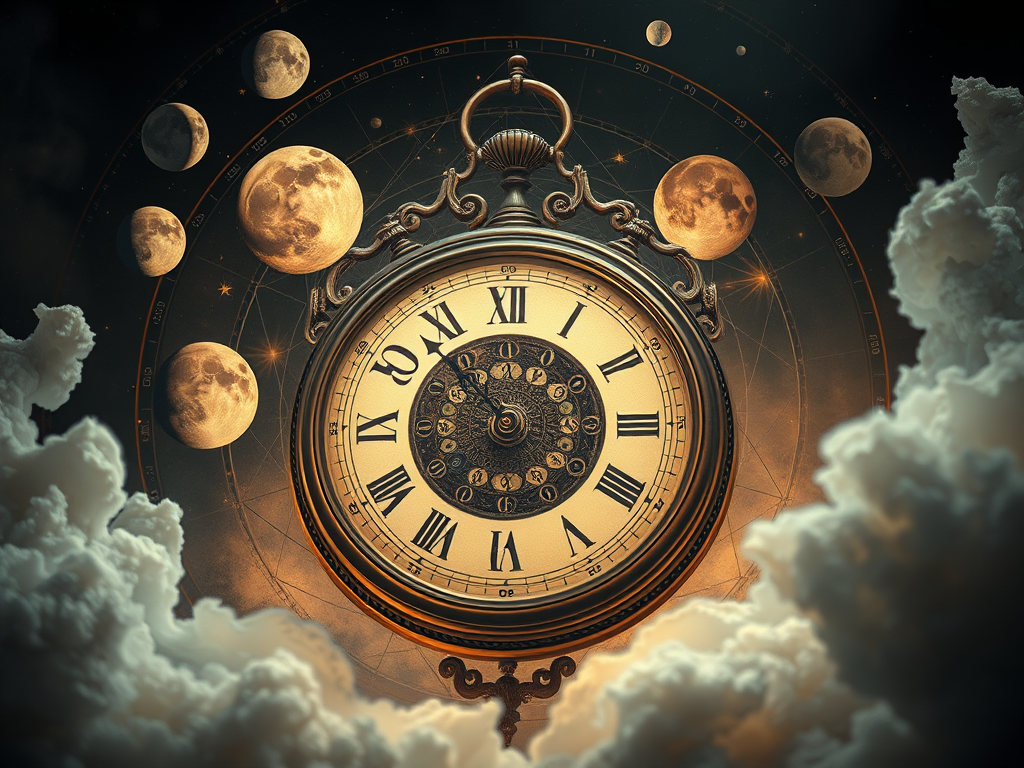
    Long before civilization had clocks or kings, time was the rhythm of survival. Early humans marked the waxing and waning of the moon, the flooding of the Nile, or the shadows cast by the sun to understand the invisible forces shaping their existence. The moon was not a symbol then — it was a teacher.

    The Lunar Beginnings

    Many of the earliest calendars, including the Sumerian, Babylonian, and early Hebrew systems, followed lunar cycles, roughly 29.5 days per month. Thirteen such cycles made 384 days — closely mirroring nature’s rhythm but slightly exceeding the solar year. The number 13, far from being unlucky, symbolized wholeness — the completion of the natural order.

    Yet the moon’s rhythm clashed with administrative order. Farmers, priests, and later empires found it difficult to standardize rituals and taxes by a cycle that drifted against the seasons. The quest for harmony between the moon and the sun became a philosophical one: how to synchronize the heavens with human need.


    III. The Roman Invention — Power Over the Year

    Before Julius Caesar, Rome’s calendar was chaos. Months drifted out of alignment with the seasons, and political leaders inserted or removed days to manipulate elections or harvest schedules. Time itself had become a tool of control — not science.

    The Julian Reform

    In 45 BCE, Julius Caesar, advised by Egyptian astronomer Sosigenes of Alexandria, instituted the Julian Calendar. It defined a year as 365.25 days, introducing an extra day every four years — the leap year — to correct for the fraction of a day lost annually.

    This was more than a reform. It was a declaration: time would no longer belong to nature, but to Rome. The emperor’s authority extended into the fabric of reality. Every empire since has followed this pattern — whoever rules the calendar, rules the mind.


    IV. The Gregorian Correction — The Church Reshapes Eternity

    By the 16th century, Caesar’s calendar was off by ten days. The drift affected the most sacred event in Christianity: Easter, meant to align with the spring equinox. In 1582, Pope Gregory XIII introduced a correction — the Gregorian Calendar, which remains the global standard today.

    The reform adjusted the leap year rule:

    • Every year divisible by 4 is a leap year,
    • Except years divisible by 100,
    • Unless divisible by 400.

    This intricate formula corrected the 11-minute annual error that had accumulated for centuries. But beneath this logic lay something more profound: the Church sought not only to realign time with nature, but to reaffirm its dominion over truth and rhythm.

    The Power Behind Precision

    By defining the calendar, the Church unified its rituals, tax schedules, and holidays — synchronizing belief with bureaucracy. The Gregorian reform disguised theological intent beneath astronomical precision. Humanity had once again traded freedom for order, chaos for conformity.


    V. Why We Have a Leap Year — The Humility of Correction

    Leap years remind us that even our most perfect systems are imperfect. The Earth doesn’t orbit the sun in an even number of days — it takes approximately 365.2422. The leap year is a confession that our logic cannot fully contain reality.

    Every four years, we add a day — not because we control time, but because we must reconcile with it. This extra day is both an act of humility and pride: humility to admit our miscalculations, pride to insist we can fix them.

    In the philosophy of The Resilient Philosopher, this represents the paradox of mastery — to lead, one must serve the rhythm of what they cannot command. Leadership is not the manipulation of order, but the alignment with truth.


    VI. The Lost 13th Month — The Time That Stood Still

    Few remember that humanity once lived by a 13-month calendar. Many ancient societies — from Egypt to Mesoamerica — built their time around 13 lunar cycles of 28 days, totaling 364 days. A single “day out of time” completed the cycle, celebrated as renewal rather than counted as labor.

    The International Fixed Calendar

    In the 20th century, reformers proposed reviving this balance. The International Fixed Calendar, championed by George Eastman (founder of Kodak), used 13 months of 28 days each. It was mathematically elegant, spiritually balanced, and efficient. Yet global powers rejected it.

    Why? Because 13 months disrupted tradition, profit, and power. Banking systems, holidays, and contracts were built around the 12-month rhythm of the Gregorian model. Even the number 13 — once sacred — became taboo, a superstition born from fear of breaking the system.

    The rejection of the 13-month cycle revealed a deep truth: humanity does not fear time — it fears change.


    VII. Time as a Political Construct

    Every civilization measures time to serve its structure of power. Calendars are not neutral tools; they are declarations of worldview.

    When Pope Gregory changed the year, he didn’t merely correct astronomical drift — he rewrote the flow of memory. When nations adopted his calendar, they didn’t just change dates — they accepted a shared illusion.

    The Gregorian calendar unified commerce, communication, and colonization. It became a global standard because it served empire — not because it was more truthful than others. Through this, time became the first universal law of obedience.

    The Servant Leader’s Reflection

    In the Resilient Philosophy, leadership means empowering truth, not bending it. When we force the world to fit our design, we lose sight of the natural cycles that sustain wisdom. True time is not linear — it is cyclical. It returns, teaches, and evolves. The Gregorian calendar flattened the circle into a line, and in doing so, humanity began to measure life by deadlines instead of dawns.


    VIII. The Spiritual Consequence — Losing the Sacred Rhythm

    When time became mechanical, spirituality became conditional. We began to pray by the clock, work by the schedule, and celebrate by the calendar — not by experience.

    Ancient civilizations aligned their lives with solstices and equinoxes, understanding that nature was not an obstacle but a language. The moon guided planting and birth, the sun guided harvest and rest. The modern world, however, severed that connection.

    To live by the Gregorian clock is to exist in perpetual acceleration — every hour borrowed from rest, every year stolen from reflection. We measure our lives by productivity, not purpose. The manipulation of time has become the manipulation of meaning.


    IX. The Resilient Reflection — Returning to the Natural Clock

    Time is not meant to be owned. It is meant to be understood. The Resilient Philosopher reminds us that every attempt to dominate time ends in disconnection — from nature, from others, and from the self.

    The philosopher does not rush; the leader does not command the hour. Both recognize that time is awareness, not arithmetic. To be present is to exist beyond the clock.

    Our ancestors, in their simplicity, understood something we have forgotten: the rhythm of life cannot be divided into twelve artificial cages. The moon still rises thirteen times a year. The Earth still turns without asking permission.

    To lead in harmony with time is to practice spiritual intelligence — the alignment between being and becoming.


    X. Conclusion — The Clock Within

    The story of the calendar is the story of humanity’s relationship with truth. Every reform, every leap year, every “daylight saving” change is a reminder that our systems are only as perfect as our perception.

    We invented the Gregorian calendar to control what we feared — that life was beyond calculation. But life has never asked to be measured. The philosopher learns that awareness, not precision, defines wisdom.

    “The one who tries to master time, loses it.
    The one who walks with time, finds eternity.”
    The Resilient Philosopher: Pillars & Principles

    Perhaps one day, we will no longer live by the manipulated clock, but by the rhythm of truth — where each sunrise is a new beginning, and every silence is sacred time.


    References

    • Richards, E.G. (1998). Mapping Time: The Calendar and Its History. Oxford University Press.
    • Hannah, R. (2005). Greek and Roman Calendars: Constructions of Time in the Classical World. Routledge.
    • Blackburn, B., & Holford-Strevens, L. (2003). The Oxford Companion to the Year. Oxford University Press.
    • Vatican Archives (1582). Inter gravissimas (Papal Bull of Gregory XIII).
  • Beyond Labels: Embracing the Infinity of Creation

    Beyond Labels: Embracing the Infinity of Creation

    By D. Leon Dantes | Vision LEON LLC — The Resilient Philosopher Series


    Introduction

    Humanity has always sought to name what it fears and to label what it does not understand. In doing so, we give form to mystery — and often, we confine it. The need to explain existence is both our gift and our curse. Through explanation, we evolve; through labels, we limit.

    Creation, as we know it, has never asked for definition. It simply is. It does not require our understanding, our religion, or our recognition. It exists beyond belief, beyond time, and beyond the reach of language.


    The Bias of Labels

    When we put labels on creation, we make the creation biased to where it comes from. We turn infinity into identity, and identity into division.

    Every culture names its gods, every scientist names his particles, and every philosopher names his truth — yet none can claim ownership of creation. The more we define, the more we divide, until truth itself becomes fragmented by interpretation.

    Labels give comfort to the mind but prison to the imagination. When we say “this is how creation began,” what we truly say is “this is all I can understand.” In that moment, we trade the vastness of mystery for the convenience of certainty.


    Creation as the Language of Fear

    To me, creation is simply a way to explain something feared — the unknown, the unseen, the infinite. Humanity’s greatest fear has always been insignificance.

    “Where do we belong in the universe?” That question alone has shaped civilizations. Our fear of being small led us to create gods, hierarchies, and meanings — all labels designed to comfort the soul and contain the infinite.

    But what if belonging is not found through definition, but through awareness? What if we were never meant to understand creation, only to participate in it?


    Before and After the Beginning

    Before the Big Bang was something, and long after it will remain. Our universe is not the beginning; it is a continuation — a pulse in the infinite heartbeat of existence.

    What we call “the beginning” is only the visible spark of a process that never began and will never end. To see the Big Bang as the origin of all things is to assume that time itself had a first breath. But time, like consciousness, expands in layers.

    Our universe is but one layer among many — a thread woven into an eternal tapestry that connects all forms of existence. Creation did not start with an explosion; it revealed itself through expansion. And expansion is not destruction — it is continuation.


    The Universe Without Recognition

    There is no need for labels in true creation, for creation does not seek recognition. It does not demand worship, and it does not desire praise. It came from itself and remains connected through everything it has become.

    Every atom of our being carries that same origin — the same infinite thread. We are not separate from creation; we are its echo. And yet, the more we label ourselves — by nation, religion, or ideology — the further we drift from the truth of unity.

    The universe does not say, “I am right.” It simply continues.


    The Mind’s Limitation

    We set limitations on our minds by closing our imagination. When we define what cannot be defined, we become smaller than the truth we seek. The infinite becomes unreachable not because it is hidden, but because we have decided where it must end.

    Imagination is not fantasy; it is the highest form of awareness. It is the bridge between what we know and what we have yet to remember.

    If I am wrong or right, it will not matter. Because truth is not measured by certainty, but by presence. We are here today, and tomorrow, we may be anywhere — yet still part of the same eternal movement that binds everything together.


    Philosophical Reflection

    To be alive is to exist within creation; to be aware is to witness it. The moment we try to own creation through labels, we lose its essence.

    The Resilient Philosopher does not claim to know the truth of the universe — only to feel it. To live with humility before the infinite is the beginning of wisdom.

    Freedom is not found in knowing the answer; it is found in accepting that the question itself is sacred.


    “When we label creation, we make the infinite finite. Creation was never meant to be understood — only experienced.”
    — D. Leon Dantes, The Resilient Philosopher: The Prism of Reality


    Conclusion

    The universe is not a mystery to be solved, but a connection to be remembered. We do not belong in the universe — we are the universe, expressed through consciousness and time.

    Every thought, every breath, and every act of awareness is part of that unfolding. To name it is human, but to feel it is divine.

    And so, creation continues — without label, without end, without fear.

    logo8
  • The Evolution of Religion: From Tribal Rituals to Modern Faith

    The Evolution of Religion: From Tribal Rituals to Modern Faith

    Introduction

    Religion has shaped civilization for thousands of years — guiding morality, legitimizing rulers, and inspiring art and philosophy. Yet it has also divided nations, fueled wars, and suppressed individual freedom.

    In The Resilient Philosopher: The Prism of Reality, I argue that every belief system, whether religious or secular, is a prism — refracting the same light of truth into different colors. Religion is humanity’s oldest attempt to answer the great questions: Who are we? Why are we here? What happens after death?

    By understanding religion’s evolution, we can better navigate the tension between faith and freedom, between dogma and personal growth. And in doing so, we honor one of my five pillars:

    Everything can be nothing, but nothing can’t be everything.

    Religion and spirituality may look different across cultures, but at their core, they are humanity’s way of turning the chaos of existence into meaning.


    The Similarities Between Gods Throughout History

    When we look at history through the prism of resilience, we see that humanity’s gods are archetypes — reflections of universal fears, hopes, and questions.

    Common Archetypes in Religion

    • Creator Gods: Represent our longing for purpose and order — Yahweh, Brahma, Atum, Chaos.
    • Sun Gods: Symbolize enlightenment and sustenance — Ra, Helios, Inti, Amaterasu.
    • Underworld Gods: Help us confront mortality — Anubis, Hades, Hel, Mictlantecuhtli.
    • Trickster Gods: Remind us of unpredictability — Loki, Hermes, Eshu, Coyote.

    In The Resilient Philosopher, I wrote that “the gods we create are not rulers over us but mirrors of our deepest questions.” Recognizing these archetypes empowers us to move beyond fear and into self-leadership.


    The African Origins of Religion

    Africa is not just humanity’s physical cradle — it is the spiritual cradle as well. Yoruba traditions predate most organized faiths and demonstrate that religion was first about connection — to nature, to ancestors, and to one another.

    Yoruba Religion and Its Echo in Global Faith

    • Olodumare as the Supreme Creator: The unifying source, the “zero point” in my philosophy — the beginning and end of all.
    • Orishas as Intermediaries: Similar to saints, angels, or demigods — they represent aspects of life we must learn to master.
    • Ancestor Worship: Aligns with my pillar, “Sit, reflect, and write it down — another generation will be thankful.” Ancestor veneration is about carrying forward the wisdom of those who came before us.

    When we lose sight of these roots, religion becomes rigid. When we honor them, religion becomes a living philosophy that grows with us.


    Spirituality vs. Organized Religion

    Spirituality and religion are often placed in conflict, but they can work together. In my philosophy, spirituality is the internal compass, while religion can be the map — but a map should never replace the traveler’s own wisdom.

    AspectSpiritualityReligion
    DefinitionPersonal search for meaningOrganized system of beliefs
    StructureFlexible, self-guidedInstitutionalized, rule-bound
    AuthorityInner self, natureReligious leaders, scripture
    CommunityCan be solitaryRequires communal worship

    When we let institutions take over entirely, we forget pillar four:

    To lead is to serve, by empowering others to lead and rise above.

    True spiritual leadership never cages the soul — it sets it free.


    Why There Are So Many Religions

    From a psychological and philosophical lens, religions evolve just as humans do — adapting to their environment and the needs of their people.

    • Cultural Adaptation: Rituals evolved alongside survival needs.
    • Geography: Desert religions emphasized water and covenant; forest religions focused on fertility and balance.
    • Political Power: Religion has been used to unify empires and justify conquest.
    • Reform Movements: Each split is an attempt to get closer to truth.

    My book frames this as part of the “Trinity of Life” — honesty, integrity, and spirituality. Religions break when one or more of these elements is corrupted.


    Divisions in Major Faiths

    Judaism

    • Orthodox Judaism: Resilient but rigid, prioritizing law.
    • Conservative Judaism: Balances heritage and change.
    • Reform Judaism: Seeks truth in modernity.
    • Hasidic Judaism: Mystical, centered on joy and connection.

    Christianity

    • Catholicism: Guardians of apostolic tradition.
    • Eastern Orthodoxy: Preserves ancient liturgy.
    • Protestantism: Champions individual interpretation — but also fragmentation.

    Islam

    • Sunni: Emphasizes consensus.
    • Shia: Emphasizes bloodline legitimacy.

    These divisions are not signs of weakness — they are humanity’s attempt to refine its collective understanding.


    Atheism as a Belief System

    In The Resilient Philosopher, I write that “the one who lacks words, speaks the most.” Atheism is not silence — it is a declaration that meaning is to be found in reason rather than revelation.

    • Faith in Science: Trust in rational frameworks.
    • Moral Structure: Humanist ethics replace divine command.
    • Acceptance of Uncertainty: Choosing to live without ultimate answers.

    This is not a void — it is simply a different prism through which to view reality.


    Conclusion

    Religion is neither inherently good nor evil — it is a tool. Like any tool, it can build or destroy. Our task is not to worship the tool but to use it wisely.

    The Resilient Philosopher calls us to move past dogma and into self-leadership. Faith, when lived with honesty and integrity, becomes a force for liberation, not oppression. Whether you believe in one God, many gods, or none at all, the journey is the same:

    Everything in silence will be loud. Everything loud will be gone with the wind of time. Sit, reflect, and write it down — another generation will be thankful.

    Religion’s future depends not on who holds power but on who chooses to live in truth.


    References

    • Armstrong, K. (2006). A History of God.
    • Dantes, D. L. (2025). The Resilient Philosopher: The Prism of Reality.
    • Eliade, M. (1987). The Sacred and the Profane.
    • McGrath, A. (2007). Christianity: An Introduction.
    • Esposito, J. (1998). Islam: The Straight Path.

  • Quantum Consciousness and the Illusion of Death Explained

    Quantum Consciousness and the Illusion of Death Explained

    By D. Leon Dantes — The Resilient Philosopher | Vision LEON LLC

    Introduction

    Science and spirituality have long stood at opposite ends of the human search for truth. Yet, as our understanding of quantum mechanics deepens, a subtle bridge begins to appear—a bridge between physics and philosophy, between energy and existence.

    This reflection explores a timeless question: Is death truly the end, or merely a transition within the continuum of consciousness?


    The Quantum Foundation: Energy and Observation

    The law of conservation of energy tells us that energy cannot be created or destroyed—it simply transforms. Every atom in our body, every photon that touches our skin, carries a history billions of years old. When the biological form ceases to function, that energy disperses and continues elsewhere.

    Quantum mechanics adds another layer. In the double-slit experiment, particles behave as both wave and matter until measured. This phenomenon reveals a mysterious truth: reality exists in a superposition of probabilities until observation defines it.

    While many scientists caution against equating “observation” with human consciousness, the metaphor remains powerful. Our awareness participates in the act of creation, even if only through perception. The world we experience is not separate from us—it is interpreted, shaped, and given meaning by our consciousness.


    Biocentrism and the Continuum of Consciousness

    Dr. Robert Lanza, author of Biocentrism: How Life and Consciousness Are the Keys to Understanding the True Nature of the Universe (2007), proposed that life does not arise from the universe—rather, the universe arises from life. In his view, consciousness is not a byproduct of matter; it is the foundation from which matter manifests.

    Critics argue that biocentrism lacks empirical proof, but its philosophical implications are profound. It suggests that death is not the annihilation of consciousness, but a transition in perspective. The observer—the self—may continue to exist in a different dimension, vibration, or plane of awareness, even if the physical vessel ceases.

    This concept aligns with The Resilient Philosophy’s idea that everything can be nothing, but nothing cannot be everything.
    If energy transforms but never dies, consciousness—its most refined expression—may likewise shift rather than disappear.


    Max Planck and the Quantum Soul

    The German physicist Max Planck, father of quantum theory, once said:

    “I regard consciousness as fundamental. I regard matter as derivative from consciousness.”

    Planck’s insight dismantles materialism’s rigid walls. It suggests that what we perceive as physical reality is a manifestation of a deeper, non-material consciousness—a field of awareness that gives rise to form.

    If consciousness precedes matter, then death cannot be a definitive end. It becomes a reconfiguration within that primary consciousness, much like a wave returning to the ocean that gave it birth.


    The Multiverse Hypothesis: Infinite Possibilities

    The many-worlds interpretation of quantum mechanics, introduced by Hugh Everett III in 1957, proposes that every quantum event spawns multiple realities. Each choice, each collapse of probability, births another universe.

    If true, then consciousness might not vanish at death—it could continue in a parallel reality where the observer persists. This idea, while speculative, offers a poetic vision of immortality through infinite potential.

    Even if the multiverse remains theoretical, it symbolizes the resilience of existence itself—that no state of being is final, and that what we call “ending” may only be a redirection within the grand architecture of the cosmos.


    Philosophical Reflection: The Prism of Reality

    In The Resilient Philosopher: The Prism of Reality, I wrote:

    “In the silence between breaths lies the echo of eternity. Death is not silence—it is the sound of transformation.”

    To understand consciousness through this prism is to realize that death is not the enemy of life but its companion. Every birth demands a transformation; every transformation demands release. What we mourn as loss may simply be the soul’s transition to a frequency beyond our perception.

    This is the heart of The Trinity of Life: Honesty, Integrity, and Spirituality.
    Honesty accepts mortality.
    Integrity honors the cycle of energy.
    Spirituality recognizes that the end is never the end—only the unfolding of a new beginning.


    Scientific Reality and Philosophical Balance

    Factually, no empirical evidence confirms that consciousness survives death. Neuroscience still ties awareness to brain function. Yet, even within that limitation, the mystery remains unsolved.

    Physics cannot yet define what consciousness truly is, only how it behaves when embodied. That uncertainty invites philosophy—not to replace science, but to remind us that truth often hides in paradox.

    Thus, while we must acknowledge the limits of evidence, we may also accept the possibility that reality extends beyond those limits. To deny that possibility would be to deny the very curiosity that defines humanity.


    Conclusion: The Soul Beyond the Equation

    If energy never dies, and consciousness shapes the perception of reality, then perhaps death is not an illusion but a shift in awareness. We are fragments of an eternal field, experiencing temporary boundaries.

    To live resiliently is to understand this: we are not the bodies that fade, but the awareness that observes their fading.
    And in that awareness, nothing is ever lost—only transformed.

    “Everything in silence will be loud. Everything loud will be gone with the wind of time. Sit, reflect, and write it down—another generation will be thankful.”
    The Resilient Philosopher: The Prism of Reality


    Call to Action

    If this reflection moved you, support the mission of Vision LEON LLC—a family-run movement dedicated to leadership, mental health, and human resilience across the world.

    Visit our GoFundMe page to help keep The Resilient Philosopher Podcast and our website ad-free and accessible to all.

    Explore more reflections in The Resilient Philosopher: The Prism of Reality and join the conversation at visionleon.com.

    Together, we can reshape how humanity understands life, leadership, and the eternal consciousness that unites us all.


    References

    • Lanza, R. (2007). Biocentrism: How Life and Consciousness Are the Keys to Understanding the True Nature of the Universe. BenBella Books.
    • Planck, M. (1931). The Nature of Matter, speech to the German Physical Society, Florence.
    • Everett, H. III. (1957). “Relative State” Formulation of Quantum Mechanics. Reviews of Modern Physics, 29(3), 454–462.
    • Penrose, R. & Hameroff, S. (2014). Consciousness in the Universe: A Review of the ‘Orch OR’ Theory. Physics of Life Reviews, 11(1).
    • Heisenberg, W. (1927). Über den anschaulichen Inhalt der quantentheoretischen Kinematik und Mechanik. Zeitschrift für Physik, 43(3–4), 172–198.
    logo8