Tag: spirituality

  • Exploring the Many Faces of God: A Philosophical Journey

    Exploring the Many Faces of God: A Philosophical Journey

    Series: The Animal That Needed Heaven: What Are We Calling God?

    “Maybe the question is not only whether God exists, but what humanity has been naming when it says God.”
    — D. L. Dantes

    Introduction

    After humanity woke up inside existence, it began asking questions that instinct could not answer. Where did we come from? Why do we suffer? Why do we die? What happens to those we love? Is there something beyond the visible world, or are we only naming our fear of the unknown?

    The word God carries all of those questions at once. For some, God is the Creator. For others, God is Father, judge, spirit, source, energy, nature, consciousness, moral order, or mystery itself. Maybe the disagreement begins because humans often use the same word while pointing toward different meanings.

    The Name Behind the Mystery

    When people say God, they may not always mean the same thing. One person may imagine a personal being who listens, judges, forgives, and intervenes. Another may imagine the force that holds reality together. Another may see God as the source of morality, the ground of existence, or the name we give to what cannot be fully explained.

    This doesn’t make the word meaningless. It makes the word heavy. God becomes the place where human language reaches its limit. The mind tries to name what it cannot hold, and the name becomes sacred because it carries both wonder and fear.

    God, Energy, and Existence

    There is a tempting thought that God may be like energy: unable to be created or destroyed, only present in different forms. That idea can be philosophically powerful, but it should be handled carefully. Science can describe energy, matter, time, and transformation, but science doesn’t automatically tell us whether those realities are divine.

    Still, the thought remains useful. If God is not a figure above the clouds, then perhaps God is closer to the reality beneath all realities. Perhaps God is not somewhere else, but the name humans give to the source, order, or mystery that allows anything to exist at all.

    The Problem of Ownership

    The danger begins when humans stop asking what God means and start claiming ownership over God. A mystery becomes a doctrine. A doctrine becomes an institution. An institution becomes an identity. Then the sacred, which may have begun as wonder, becomes another human boundary.

    Maybe this is why religions divide even when they speak of unity. The problem may not be that people believe in God. The problem is that people often want God to confirm their group, their language, their authority, their wounds, and their version of the world.

    The Sacred Responsibility of Earth

    If God exists, then life on earth should matter. If God doesn’t exist, life on earth still matters because this is the only realm we know directly. Either way, the responsibility returns to how we live with one another while we are here.

    That may be the most honest place to begin. Before arguing about heaven, hell, spirits, dimensions, or final judgment, we can ask whether we have been kind, whether we have loved, whether we have helped, whether we have reduced suffering, and whether we have contributed to the survival and dignity of humanity.

    Closing Reflection

    Maybe God is the Creator. Maybe God is the source. Maybe God is nature, energy, consciousness, moral order, or the mystery behind existence. Maybe humanity has been using one word to reach toward many possibilities at once. But if the idea of God does anything worthy, it should not make us careless with earth or cruel to one another. It should remind us that existence is already sacred enough to demand humility, compassion, and responsibility.

    By D. L. Dantes, The Resilient Philosopher

    End of series: The Animal That Needed Heaven

    Leave a comment and share this article with others who may benefit from the reflection.
  • The Awakening of Humanity: From Instinct to Awareness

    The Awakening of Humanity: From Instinct to Awareness

    Series: The Animal That Needed Heaven: When Humanity Woke Up

    “Maybe religion began when the human animal woke up inside existence and could no longer survive on instinct alone.”
    — D. L. Dantes

    Introduction

    Imagine someone in a deep sleep. While they are sleeping, someone moves them into another room, changes the scenery around them, and leaves them there. When they wake up, they are not calm at first. They are disoriented. They want to know where they are, how they got there, why they are there, and who moved them.

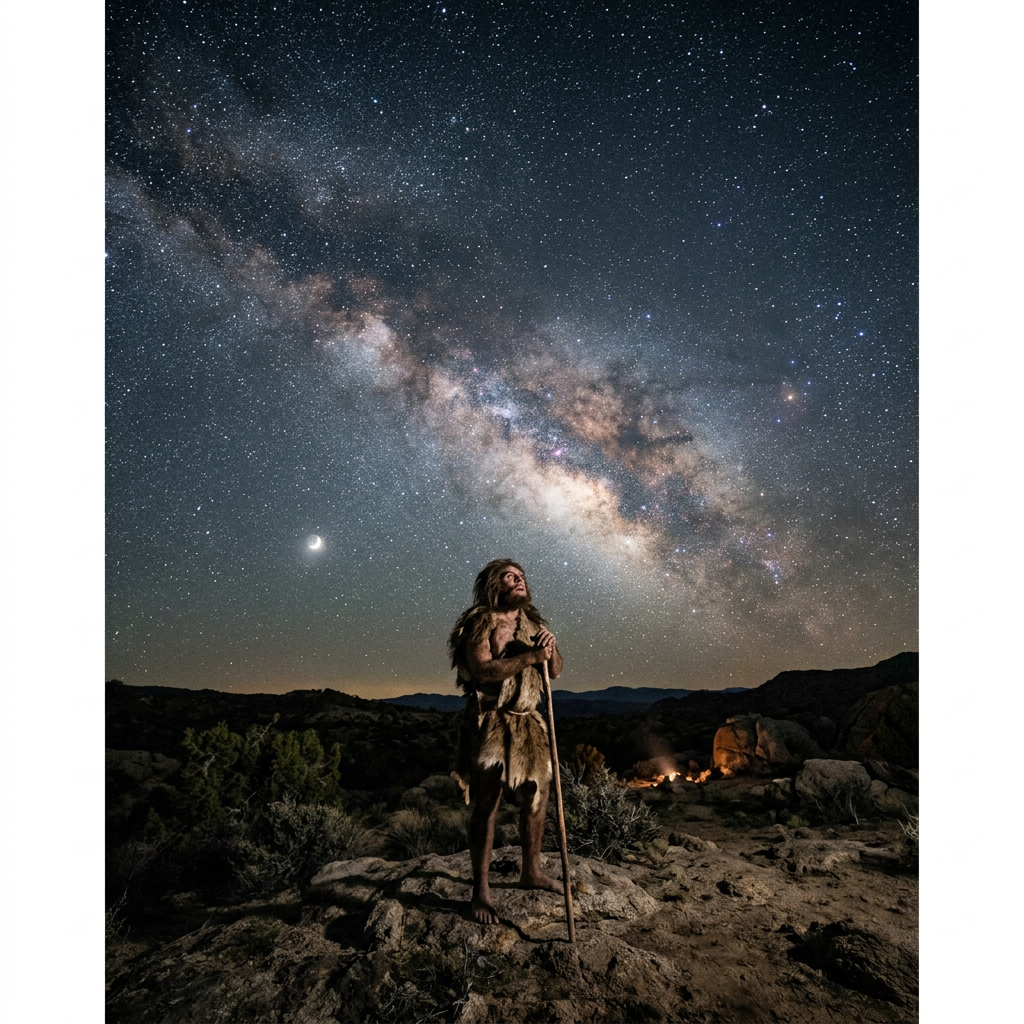
    That may be close to what happened when humanity became self-aware. The animal that once survived by instinct began to notice itself inside existence. It could feel hunger, danger, desire, and pain, but now it could also ask questions. It could look at the sky, the dead body, the storm, the child, the river, the harvest, and the fire, and wonder what all of it meant.

    The Shock of Awareness

    Before awareness becomes wisdom, it becomes confusion. To wake up inside existence is not only to see the world, but to realize that the world was already there before we understood it. Humanity didn’t create the sun, the moon, the seasons, the body, or death. It simply woke up surrounded by them.

    That awakening must have carried a strange burden. Human beings could shape tools, build shelters, redirect water, plant crops, and form communities, but they couldn’t explain the source of their own being. The more humanity learned to create, the more it had to ask the question that still follows us today: if we can create, what created us?

    When Instinct Was Not Enough

    An animal can run from danger without asking why danger exists. A human being can run from danger and then sit by the fire wondering why suffering follows life. That difference matters. Human consciousness didn’t remove instinct. It added reflection to instinct, and reflection made survival heavier.

    This is where religion may have found its first psychological opening. Not because early humanity was foolish, but because self-awareness created questions that instinct couldn’t answer. A body wants food, shelter, air, and safety. A mind wants meaning, origin, purpose, morality, and continuity beyond death.

    The Birth of the Sacred Question

    Once humanity became aware of death, life became more than survival. A body can fight death, but the mind has to live with the knowledge that death is coming. That awareness changes everything. It turns grief into memory, memory into ancestry, ancestry into reverence, and reverence into sacred story.

    Maybe gods, spirits, heavens, ancestors, and unseen realms began as humanity’s attempt to organize the unknown. The storm was no longer only weather. The harvest was no longer only food. The dead were no longer only gone. The world became full of meaning because the human mind could no longer live in a world that felt meaningless.

    Religion as Human Orientation

    This is not an attack on faith. It is a philosophical reflection, not a clinical analysis or theological assault. Where psychological science becomes relevant, it can serve as a point of contact, but not as a final verdict. The real question here is not whether God exists. The question is why the idea of God appears wherever human beings confront suffering, death, morality, and the unknown.

    Religion may have helped humanity orient itself. It gave language to fear, ritual to grief, structure to morality, and community to survival. But the same force that can unite people around meaning can also divide them through ownership, doctrine, authority, and control. That is the paradox humanity still carries.

    Closing Reflection

    Maybe humanity didn’t create religion simply because it wanted power over others. Maybe religion began because the human animal woke up and realized that survival alone was not enough. We needed to know why we were here, where we came from, what happened to those we lost, and whether our suffering had meaning. The sacred question began when awareness became too heavy for instinct to carry by itself.

    By D. L. Dantes, The Resilient Philosopher

    Next in the series: The Animal That Needed Heaven

    Leave a comment and share this article with others who may benefit from the reflection.

  • Exploring Spirituality: Insights from an Observer’s View

    Exploring Spirituality: Insights from an Observer’s View

    Series: The Animal That Needed Heaven: Why I Write as an Observer

    “I honor the gods in the same way I honor my ancestors. I don’t need them to be true for them to matter.”
    — D. L. Dantes

    Introduction

    I don’t write about religion because I’m trying to convince anyone to believe what I believe. My personal beliefs are not the center of this work. I write from the perspective of an observer, someone trying to understand why human beings create meaning, protect traditions, divide over interpretation, and search for something beyond what can be seen.

    At a young age, while reading the Bible, I learned that trying to understand everything immediately could limit my ability to learn more later. When I didn’t understand something, I set it aside. I wrote it down. I allowed time, experience, and reflection to return me to the question with a wider mind.

    Belief as Examination

    In that sense, we can all become theologians of our own beliefs. Not because we all hold religious authority, but because we all carry assumptions about life, death, morality, suffering, and meaning. The real question is not only what others believe. The deeper question is what we are doing with what we believe.

    Belief becomes dangerous when it is used only to judge others. It becomes useful when it forces us to examine our own actions. If faith, philosophy, or spirituality doesn’t lead us toward compassion, responsibility, and service, then we have to ask whether we are honoring the sacred or only defending an identity.

    The Observer’s Position

    This series is not an attempt to create a new religion, reject all religion, or replace faith with another belief system. I don’t need religion to feel close to myself, but I do understand why spirituality matters. Spirituality belongs to culture, ancestry, memory, grief, movement, inner energy, and the stories people use to survive.

    Whether gods, spirits, ancestors, or unseen realms are literally true is not the only question that matters. The fact that people have carried these ideas across generations already tells us something important. These beliefs carry memory. They carry warning. They carry identity. They carry the emotional history of tribes, families, nations, and communities.

    Action Before Certainty

    I don’t believe life becomes meaningful only because of where we think we are going after death. Life becomes meaningful through how we live now. Have we been kind? Have we shown love? Have we helped others? Have we contributed to the survival and dignity of those around us?

    Working together matters more than winning arguments about belief. A person can believe in God and still fail to love others. A person can reject organized religion and still live with compassion. What matters most is not the label we defend, but the consequences of our choices.

    Closing Reflection

    I honor ancestral knowledge because it connects us to those who came before us. I honor spiritual stories because they reveal what people feared, loved, protected, and hoped to pass forward. I don’t need every god, spirit, or sacred story to be literally true for it to hold meaning. I don’t seek to change your point of view. I seek to learn from it.

    By D. L. Dantes, The Resilient Philosopher

    Next in the series: When Humanity Woke Up

    Leave a comment and share this article with others who may benefit from the reflection.

  • When Symbols Meet Science

    When Symbols Meet Science

    “Facts correct belief, but symbols preserve meaning.” – D. L. Dantes

    Introduction

    One of the problems people run into when discussing spirituality, religion, and science is that they often treat them as if only one can survive. If science proves something, then all symbolism must be childish. If a symbol carries meaning, then facts must somehow become secondary. I do not see it that way. A thing can be factually wrong and still hold symbolic value. What should not happen is allowing symbolic meaning to overrule reality once the facts are clear.

    That distinction matters because human beings have always tried to explain life before fully understanding it. Stories, myths, rituals, and prayers helped people make sense of suffering, change, loss, survival, and hope. They were not always scientific, but they were meaningful. The mistake comes when we confuse meaning with mechanism. A story may help a person endure life without becoming a literal explanation of how life works. When we fail to separate those two things, belief becomes stubborn where it should be humble.

    Meaning Without Literalism

    I do not consider myself an atheist, but I do not consider myself devoted to religion either. I leave room for spirituality, reflection, gratitude, and even prayer, but not at the expense of evidence. If I pray for food and never go find it, then prayer alone will not feed me. If I thank a god and it helps me face the day with more self-respect and calm, then that gratitude may still serve a psychological and emotional purpose. The meaning can be real even when the interpretation remains personal rather than provable.

    That is where symbols still matter. Human beings need language for grief, fear, love, purpose, and transformation. Sometimes a symbol carries those things better than a chart or a formula ever could. Yet symbols must remain in their proper place. They can enrich meaning, but they cannot replace evidence. Once a claim is disproven, the claim must yield. What should remain is not the false explanation, but the human lesson that was carried inside it. Facts should guide explanation, while symbols help us carry meaning without pretending that meaning itself is proof.

    The Discipline of Evidence

    This is why mythology still has value even when science has moved beyond it. A story like Demeter and the changing seasons may no longer function as a literal explanation of the natural world, but it still speaks to grief, loss, separation, and return. The science of the seasons does not destroy the symbolic meaning of the story. It simply removes the need to treat the story as mechanism. That is an important difference. Truth at the level of fact and truth at the level of meaning are not always the same kind of truth.

    The same problem appears in modern life whenever people cling to conspiracies, exaggerations, or ideological certainties that cannot stand up to evidence. When a person becomes more loyal to the story than to reality, they stop seeking truth and start defending identity. At that point, the narrative functions like dogma. It no longer invites reflection. It demands submission. That is why evidence matters so much. A person should not be convinced by the loudest voice, but by the clearest case. And even when facts challenge a belief that once brought comfort, maturity requires the courage to let the belief change.

    “Symbol can guide the heart, but evidence must guide the mind.” – D. L. Dantes

    There is no shame in admitting that earlier generations explained life with the tools they had. There is also no virtue in refusing better understanding once it arrives. Science does not have to erase wonder, and spirituality does not have to become superstition. The better path is more disciplined than both extremes. Accept what can be shown. Respect what still carries meaning. And never confuse a meaningful symbol with proof of literal truth. When symbols meet science honestly, neither has to destroy the other. Each simply has to remain in its proper place.

    By D. L. Dantes, The Resilient Philosopher

    Leave a comment and share this article with others who may benefit from the reflection.

  • The Biographies of Meaning: Symbols, Energy, and the Ethics of the Self

    The Biographies of Meaning: Symbols, Energy, and the Ethics of the Self

    The Resilient Philosopher

    This series was never about gods.

    It was about humans.

    It was about the symbols we create when reality exceeds our capacity to explain it, control it, or emotionally survive it. Across cultures, across centuries, across belief systems, humanity has always turned to symbols not because we are weak, but because we are complex.

    We are multidimensional creatures.

    We exist simultaneously in the physical, emotional, psychological, ethical, and symbolic realms. To pretend otherwise is to misunderstand ourselves. What we cannot yet understand, we imagine. What we imagine, we narrate. What we narrate, we ritualize. And what we ritualize, we eventually mistake for truth if we are not careful.

    Imagination is always greater than reality.
    But imagination is not reality.

    That distinction matters.


    Why Symbols Exist

    Symbols are not lies. They are tools.

    A plate is not food, yet the moment we see a plate, we understand eating. We do not need the plate, but the plate organizes behavior, expectation, and meaning. Symbols work the same way.

    They compress complexity into something the psyche can carry.

    Athena was never reason itself.
    She was the symbol of disciplined thought under pressure.

    Xangô was never thunder itself.
    He was the symbol of consequence when justice is ignored.

    Isis was never restoration itself.
    She was the symbol of gathering what remains after collapse.

    These figures were never meant to replace responsibility. They were meant to illuminate it.

    The danger was never symbolism.
    The danger was literalism.


    The Failure of Outsourced Morality

    One of the reasons this series matters is because of what it rejects.

    Throughout history, especially within institutional Christianity, morality was often outsourced. Everything that went wrong became the devil’s fault. Everything that went right became God’s favor. Humans remained spectators in their own ethical failures.

    That structure does not produce virtue.
    It produces excuses.

    If good is not earned, gratitude becomes entitlement.
    If evil is not owned, accountability disappears.

    This is not spirituality.
    It is moral evasion.

    Any system that removes responsibility from the self corrupts ethics at the root.


    The Self Is Not Divine

    But It Is Central

    This is where my position is often misunderstood.

    I do not believe the self is divine.
    I believe the self is where ethics live.

    No god thinks for you.
    No demon acts for you.
    No belief system chooses for you.

    Only the self does.

    That is why, in my philosophy, the Trinity of Life is simple and non negotiable:

    Honesty.
    Integrity.
    The Self.

    Honesty aligns you with reality as it is.
    Integrity aligns your actions with your values.
    The Self is the agent that must live with the consequences.

    Remove any one of these and ethics collapse.


    Energy, Not Divinity

    Everything exists because energy transforms.

    This is not belief.
    This is physics.

    Energy cannot be created or destroyed. It only changes form. Matter, life, heat, motion, consciousness, decay, and renewal all exist within this system.

    That is why energy is the only concept that remains consistent across all creation.

    Not selective.
    Not moralized.
    Not punitive.
    Not rewarding.

    It simply is.

    Calling this divine adds nothing. It only reintroduces hierarchy, intention, favoritism, and dogma. The moment something is declared divine, it becomes owned, interpreted, and weaponized.

    Energy does not need worship.
    It needs understanding.


    Why Symbols Still Matter

    Rejecting literal gods does not mean rejecting symbols.

    It means reclaiming them.

    When symbols are understood as symbolic, they stop possessing us. They become mirrors instead of masters.

    Each figure in this series represented a function of the psyche:

    Isis taught restoration without denial.
    Xangô taught justice without cruelty.
    Athena taught reason without arrogance.
    Apollo taught order without control.
    Artemis taught autonomy without isolation.
    Hekate taught choice without illusion.
    Anubis taught endings without hatred.
    Odin taught knowledge without comfort.

    Together, they formed a map, not a pantheon.

    A map of what it means to live consciously.


    Ethics Must Be Universal or They Are Worthless

    The final truth this series points toward is simple and uncomfortable.

    Ethics must apply everywhere, or they apply nowhere.

    Any belief system that:

    • suppresses questioning
    • punishes doubt
    • selects who deserves dignity
    • claims exclusive access to truth

    is not ethical. It is controlling.

    Reality does not operate selectively.
    Energy does not choose favorites.
    Consequences do not respect belief.

    So neither should ethics.


    Closing Reflection

    This series was never about reviving gods.

    It was about stripping spirituality of excuses.

    Symbols help us understand the unknown.
    But responsibility belongs to the self.

    Meaning is not granted.
    It is constructed through honesty, integrity, and action.

    We come from energy.
    We return to energy.
    What we do in between is the only thing that carries ethical weight.

    That is not faith.
    That is fact.

    And if there is anything that should hold humanity together, it is not fear of gods or demons, but the shared knowledge that we are accountable to reality itself.

    That is where ethics begin.
    That is where spirituality matures.
    And that is where this series ends.

  • The Resilient Philosopher’s City: Building the Future Through the Trinity of Life

    The Resilient Philosopher’s City: Building the Future Through the Trinity of Life

    How would you design the city of the future?

    Introduction: Why the Future Needs Philosophy, Not Just Technology

    People often imagine the city of the future with flying cars and towering skyscrapers. They also picture artificial intelligence controlling every movement of life. Yet, true progress cannot be defined by machines alone. A resilient city must be rooted in philosophy. The Resilient Philosopher’s City is built on the Trinity of Life: honesty, integrity, and spirituality.

    This city is not designed for profit—it is designed for people.


    Economics: Redefining Wealth as Collective Resilience

    The economy of the future cannot mirror the economy of today, which thrives on inequality and short-term consumption. Instead, The Resilient Philosopher’s City will measure prosperity through collective resilience.

    • Honesty in economics ensures transparent systems where corruption has no room to hide.
    • Integrity in economics builds a foundation where businesses are rewarded for long-term sustainability, not exploitation.
    • Spirituality in economics teaches that money is a tool, not a god.

    This means housing, healthcare, food, and education are guaranteed foundations—not privileges. Citizens are free to grow, innovate, and create without the fear of losing their basic dignity.


    Government: Servant Leadership, Not Authority

    The Resilient Philosopher’s City does not operate under rulers, but under servant leaders. Power exists to serve, not to dominate.

    • Honesty in government ensures laws are transparent and accessible to all.
    • Integrity in government demands that leaders remain accountable and power remains temporary.
    • Spirituality in government reflects that stewardship belongs to the people, not the few.

    In this vision, propaganda has no place. Leadership is not measured by obedience but by empowerment. This city becomes a living democracy of service. Leaders rise and fall based on their ability to strengthen the resilience of others.


    Spirituality: The Silent Core of the City

    If economics sustains the body and government sustains order, spirituality sustains the soul. This city does not bind spirituality to dogma but embraces it as reflection, silence, and personal truth.

    • Honesty in spirituality refuses to manipulate with fear or false salvation.
    • Integrity in spirituality protects spaces of silence, meditation, and collective reflection.
    • Spirituality itself honors life as sacred through gardens, art, and the sanctity of quiet.

    In this city, there are spaces where people can retreat into silence, because resilience is not only survival—it is transformation.


    The Living Philosophy of the Future

    The Resilient Philosopher’s City is not a utopia—it is resilience in motion. It is a city where economics empowers, government serves, and spirituality enlightens. Every structure, law, and communal space is designed around the Trinity of Life.

    The city of the future cannot simply be technological. It must be philosophical. A place where honesty, integrity, and spirituality are not ideals but daily practices. A city that proves humanity thrives not by dominating nature or each other, but by living in balance with both.


    🌟 Call to Action: Live as a Resilient Philosopher

    If this vision resonates with you, explore deeper in my books:

    • The Resilient Philosopher: The Prism of Reality
    • Leadership Lessons from the Edge of Mental Health
    • Mastering the Self: The Resilient Mind Vol. 2

    🎙️ Listen to The Resilient Philosopher Podcast for reflections on leadership, resilience, and silence.


    📌 Author & Resources

    D. León Dantes
    Author | Philosopher | Leadership Coach
    Founder of Vision LEON LLC
    Host of The Resilient Philosopher Podcast

    📘 Leadership Lessons from the Edge of Mental Health – Buy on Amazon

    📘 Leadership Lessons from the Edge of Mental Health – Listen on Audible

    📘 Mastering the Self: The Resilient Mind Vol. 2 – Buy on Amazon
    📘 The Resilient Philosopher: The Prism of Reality – Buy on Amazon

    📚 Amazon Author Page – D. León Dantes

    🎙️ The Resilient Philosopher Podcast – Listen on Spotify
    📰 The Resilient Philosopher Chronicles – Subscribe on Substack

    📬 LinkedIn Presence:
    Newsletter: The Resilient Philosopher
    The Resilient Philosopher – LinkedIn Page
    Showcase: D. León Dantes

  • Discovering Insights from the Resilient Philosopher

    Discovering Insights from the Resilient Philosopher

    The Resilient Philosopher

    Daily writing prompt
    How are you creative?

    Writing as Stewardship: Why The Resilient Philosopher Exists

    I share my philosophy through The Resilient Philosopher podcast and my blog, through every book I have written and every book I will write. Not because I have all the answers, but because good news is never late and it never arrives at a bad time. Truth does not operate on urgency. It operates on readiness. That is why I write so much.

    For many years, I held back. Not because I lacked thoughts, but because I was still searching for my voice. I was learning how to speak without adding noise. What I offer now is not reaction. It is reflection. Not volume, but clarity. Writing became the space where my voice could exist without permission, without interruption, and without compromise.

    As I wrote in The Resilient Philosopher: The Prism of Reality:

    “This book is not here to make you agree. It is here to make you think. It is a conversation between who you are and who you still have the power to become.”

    That sentence is not marketing. It is a declaration of intent.


    Philosophy Is Lived Before It Is Written

    My work does not begin in theory. It begins in lived experience. Writing about systems and servant leadership is necessary because systems shape behavior, reward dysfunction, and punish integrity when left unexamined. Writing about mental health is necessary because leadership without psychological awareness becomes tyranny. Writing about self-care is necessary because burnout is not weakness, it is a signal.

    In Leadership Lessons from the Edge of Mental Health, I wrote:

    “Leadership is not about power. It is about responsibility. And responsibility begins with the ability to lead yourself when no one is watching.”

    This philosophy was not formed in classrooms or boardrooms. It was formed in recovery, in reflection, and in moments where silence was the only honest response. I write because writing allows me to share experience without turning it into spectacle.


    From Dogma to Consciousness

    My spiritual journey matters because it shaped how I see authority, belief, and truth. I was once a Jehovah’s Witness. That chapter of my life taught me discipline, structure, and devotion, but it also taught me what happens when belief replaces inquiry. Becoming a spiritualist was not rebellion. It was alignment.

    In The Resilient Philosopher, I wrote:

    “Spirituality is not anti-religion. It is post-religion. It begins when the soul refuses to be owned.”

    That line exists because I lived it. I learned that faith without ethics becomes control, and belief without reflection becomes obedience. My philosophy does not reject meaning. It insists on responsibility.


    Mastery Begins in Silence

    At the core of my work is the idea that leadership begins internally. Before strategy, before influence, before systems, there is self-command. In Mastering the Self: The Resilient Mind Vol. 2, I wrote:

    “Self-command is not the loud roar of dominance. It is the quiet power of alignment.”

    This is where servant leadership actually begins. Not in serving others performatively, but in mastering reaction, emotion, and impulse. Silence is not absence. It is discipline. It is the pause between stimulus and response where character reveals itself.

    Another excerpt from Mastering the Self states:

    “Victory in life is won not by the loudness of your voice, but by the clarity of your choice.”

    That sentence is a mirror. It reflects who we are when no one applauds.


    The Reader Is the Other Half of the Philosophy

    My philosophy does not exist in isolation. The Resilient Philosopher is incomplete without you. The reader is not an audience. The reader is the other half of the work. Philosophy only matters when it invites responsibility, not agreement.

    As written in the introduction of The Resilient Philosopher:

    “This book is not a map. It is a compass. It will not tell you who to become. It will challenge you to decide.”

    That is how I view leadership, writing, and ethics. I do not tell people what to think. I invite them to think with courage.


    Humanity, Nature, and Stewardship

    We are not separate from nature. We belong to it. We are not rulers of a kingdom, but participants within it. Stewardship, not ownership, is the ethical position of leadership.

    In Leadership Lessons from the Edge of Mental Health, I wrote:

    “Power is measured not by who you control, but by who you empower.”

    This applies to systems, organizations, families, and the self. Leadership that forgets its responsibility to humanity eventually collapses under its own weight.


    Why I Continue to Write

    I write because silence without reflection becomes apathy. I write because too many systems reward noise and punish thought. I write because lived experience deserves a language that honors it. And I write because philosophy is not meant to be archived. It is meant to be practiced.

    The Resilient Philosopher is not a brand. It is a living philosophy. One that believes knowledge must be loved, ethics must be lived, and humanity must be remembered.

    If there is one truth that runs through every book, every episode, and every reflection, it is this:

    We are human first. And that alone demands responsibility.

    7 Podcast Insights from The Resilient Philosopher

  • The Multiverse and Human Consciousness: Searching for Meaning Beyond One Reality

    The Multiverse and Human Consciousness: Searching for Meaning Beyond One Reality

    Introduction – The New Myth of the Multiverse

    Throughout history, humanity has sought answers to the great question of existence: What happens beyond this life? Ancient cultures created myths, religions offered heavens, reincarnation, or eternal rest, and philosophy wrestled with the soul. Today, modern physics proposes something equally captivating—the multiverse. Scientists suggest that our universe may not be unique, but one among infinite realities.

    Yet, the multiverse is more than a scientific concept. It is a new myth of our age, a secular vision of immortality. When we reflect through the eyes of The Resilient Philosopher, we see the multiverse not only as physics but as philosophy—a mirror of our endless search for meaning beyond one reality.


    The Multiverse Through the Pillars of The Resilient Philosopher

    Everything can be nothing, but nothing cannot be everything

    In the multiverse, every possibility exists. There may be a version of you who made a different choice, a version of Earth that never knew war, a reality where silence dominates instead of noise. But infinity carries a paradox: if everything exists, then significance dissolves, almost becoming nothing.

    Here lies the challenge: If infinite versions of you exist, does this one matter less—or does it matter more?
    The Resilient Philosopher answers: this moment matters most, for it is the one you are responsible for living.

    Every day is a great day to learn something new

    If infinite realities exist, knowledge itself becomes infinite. We can never “arrive” at the final truth, because learning is endless. Every choice, every mistake, and every reflection contributes to an eternal education. The multiverse is not an escape from learning but a deeper invitation to embrace curiosity and resilience.

    The Trinity of Life – Honesty, Integrity, Spirituality

    • Honesty demands we confront our limitations—we may never prove the multiverse.
    • Integrity requires that we act responsibly in this universe, regardless of how many others exist.
    • Spirituality reminds us that what cannot be proven may still guide us, for unseen truths often shape the most resilient lives.

    Consciousness and the Self Across Infinite Realities

    Science tells us consciousness is brain activity. Philosophy insists it is awareness beyond matter. The multiverse offers another possibility: perhaps consciousness is not confined to one body but scattered across infinite versions of the self.

    But this raises the timeless question: If multiple versions of you exist, which one is the authentic self?

    The Resilient Philosopher offers this: authenticity is not about multiplicity but responsibility. The self is not defined by the possibility of infinite lives, but by how you live this one.


    Ethics in a World of Infinite Possibilities

    If every choice is lived out in some parallel world, morality cannot be measured by outcomes. We cannot justify actions by saying, “in another universe, this turned out well.”

    True resilience and leadership must be rooted in principles, not probabilities. To lead is to serve—and even if infinite worlds exist, the act of serving others in this one creates meaning that no other universe can erase.


    Silence in the Midst of Infinity

    The multiverse speaks of infinite noise: countless worlds, choices, and destinies. But The Resilient Philosopher teaches that silence cuts through the noise.

    In silence, we return to what is real—the breath, the present moment, the self that exists now. Infinity does not liberate us from responsibility; it magnifies the weight of our choices. Every act echoes, not only across universes but within the soul.


    Conclusion – The Multiverse Within

    Whether or not the multiverse exists outside of us, it already lives within. Every dream, every imagination, every choice collapses infinite possibilities into one reality—the one you are living now.

    The philosopher’s task is not to escape into infinite universes, but to master this one. To live with resilience, integrity, and learning. To serve others and reflect deeply. For in doing so, we discover that the truest multiverse is the one within the human spirit.

  • Spiritual Integrity Over Ideological Conformity: Why I Refuse Religion

    Spiritual Integrity Over Ideological Conformity: Why I Refuse Religion

    Daily writing prompt
    How important is spirituality in your life?

    A Resilient Philosopher’s Reflection on Identity, Belief, and Belonging
    By D. León Dantes | The Resilient Philosopher | Vision LEON LLC


    “What is obvious to you, is obvious to you.”
    — John J. Medina

    This quote reshaped how I define common sense. It’s not universal. It’s personal — shaped by survival, experience, and bias. In that realization lies a profound lesson in leadership and identity.

    Today, I want to tell you a story — one that merges satire, spirituality, and self-destruction. It comes from a Cuban song about a Romanian vampire who converts to Marxism and pays the ultimate price for trying to belong. That story, like many others I reflect on in The Resilient Philosopher: The Prism of Reality, reveals why spirituality is not a performance, but a path of truth.


    🦇 A Cuban Parable: The Vampire Who Forgot He Was One

    During the rise of socialism, a Romanian vampire hides in the shadows, listening to speeches and slogans. He becomes captivated by the ideals of fairness and collective power. He begins to believe in Marxism — an ideology that, ironically, doesn’t even believe in him.

    To show he belongs, the vampire walks into daylight.
    He burns.

    Not because Marxism is evil. Not because vampires are cursed. But because he forgot what he was to gain approval from a system that had no place for him.


    🔥 The Real Cost of Self-Erasure

    This story isn’t about socialism. It’s about self-righteousness in leadership and the dangers of ideological conformity. I’ve seen leaders burn out — emotionally, spiritually, even physically — not because they were wrong, but because they betrayed their own nature to be “right.”

    In The Resilient Mind Vol. 1, I wrote that healing begins with honesty. In Volume 2, I expand on how daily spiritual alignment creates the resilience necessary to lead without losing yourself.


    🌱 What Spirituality in Leadership Means to Me

    As a spiritualist, not a religionist, I’ve come to realize this:
    Spirituality in leadership is not a trend. It’s a foundation.

    It is the refusal to trade identity for influence.

    I no longer follow systems that ask me to silence my intuition or amputate my truth. If a path demands that I erase myself, it’s not my path — it’s someone else’s performance.

    True leadership doesn’t demand you burn in daylight. It asks you to protect your flame.


    🧭 The Resilient Philosopher’s Reflection

    What’s obvious to me, is obvious to me. But that doesn’t mean others will see it. That’s where leadership begins: at the bridge between personal clarity and shared understanding.

    Spirituality, for me, is that bridge. It gives me the courage to speak when silence is easier, to stay still when crowds run, and to choose presence over popularity.


    🧠 Final Insight: Lead Like a Spiritualist, Not a Martyr

    I am not here to be right. I am here to be whole.

    I am not the vampire. I do not burn for movements that deny my nature.

    In the philosophy I live and teach, integrity is the real revolution. I walk where truth leads — even if no one follows.


    📘 Learn More

    • The Resilient Philosopher: The Prism of Reality – Explore identity, ideology, and the spiritual foundations of leadership.
    • Leadership Lessons from the Edge of Mental Health – Understand how resilience begins where silence ends.
    • Mastering the Self: The Resilient Mind Vol. 2 – A guide to reclaiming your mind, building spiritual discipline, and leading without losing yourself.

    📌 Author & Resources

    D. León Dantes
    Author | Philosopher | Leadership Coach
    Founder of Vision LEON LLC
    Host of The Resilient Philosopher Podcast

    📘 Mastering the Self: The Resilient Mind Vol. 2Buy on Amazon

    📘 Leadership Lessons from the Edge of Mental HealthBuy on Amazon

    📘 The Resilient Philosopher: The Prism of RealityBuy on Amazon

    📚 Amazon Author Page – D. León Dantes

    🎙️ The Resilient Philosopher Podcast Listen on Spotify

    📰 The Resilient Philosopher Chronicles – Subscribe on Substack

    📬 LinkedIn Presence:
    Newsletter: The Resilient Philosopher
    The Resilient Philosopher – LinkedIn Page
    Showcase: D. León Dantes