Introduction
Religion has shaped civilization for thousands of years — guiding morality, legitimizing rulers, and inspiring art and philosophy. Yet it has also divided nations, fueled wars, and suppressed individual freedom.
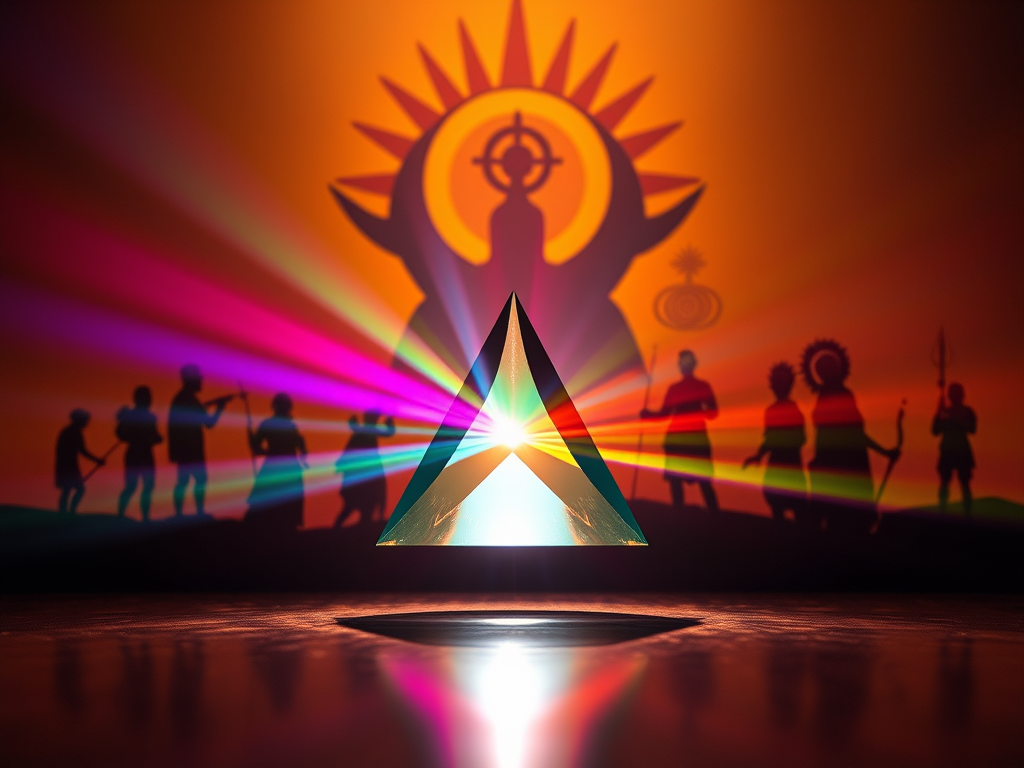
In The Resilient Philosopher: The Prism of Reality, I argue that every belief system, whether religious or secular, is a prism — refracting the same light of truth into different colors. Religion is humanity’s oldest attempt to answer the great questions: Who are we? Why are we here? What happens after death?
By understanding religion’s evolution, we can better navigate the tension between faith and freedom, between dogma and personal growth. And in doing so, we honor one of my five pillars:
Everything can be nothing, but nothing can’t be everything.
Religion and spirituality may look different across cultures, but at their core, they are humanity’s way of turning the chaos of existence into meaning.
The Similarities Between Gods Throughout History
When we look at history through the prism of resilience, we see that humanity’s gods are archetypes — reflections of universal fears, hopes, and questions.
Common Archetypes in Religion
- Creator Gods: Represent our longing for purpose and order — Yahweh, Brahma, Atum, Chaos.
- Sun Gods: Symbolize enlightenment and sustenance — Ra, Helios, Inti, Amaterasu.
- Underworld Gods: Help us confront mortality — Anubis, Hades, Hel, Mictlantecuhtli.
- Trickster Gods: Remind us of unpredictability — Loki, Hermes, Eshu, Coyote.
In The Resilient Philosopher, I wrote that “the gods we create are not rulers over us but mirrors of our deepest questions.” Recognizing these archetypes empowers us to move beyond fear and into self-leadership.
The African Origins of Religion
Africa is not just humanity’s physical cradle — it is the spiritual cradle as well. Yoruba traditions predate most organized faiths and demonstrate that religion was first about connection — to nature, to ancestors, and to one another.
Yoruba Religion and Its Echo in Global Faith
- Olodumare as the Supreme Creator: The unifying source, the “zero point” in my philosophy — the beginning and end of all.
- Orishas as Intermediaries: Similar to saints, angels, or demigods — they represent aspects of life we must learn to master.
- Ancestor Worship: Aligns with my pillar, “Sit, reflect, and write it down — another generation will be thankful.” Ancestor veneration is about carrying forward the wisdom of those who came before us.
When we lose sight of these roots, religion becomes rigid. When we honor them, religion becomes a living philosophy that grows with us.
Spirituality vs. Organized Religion
Spirituality and religion are often placed in conflict, but they can work together. In my philosophy, spirituality is the internal compass, while religion can be the map — but a map should never replace the traveler’s own wisdom.
| Aspect | Spirituality | Religion |
|---|---|---|
| Definition | Personal search for meaning | Organized system of beliefs |
| Structure | Flexible, self-guided | Institutionalized, rule-bound |
| Authority | Inner self, nature | Religious leaders, scripture |
| Community | Can be solitary | Requires communal worship |
When we let institutions take over entirely, we forget pillar four:
To lead is to serve, by empowering others to lead and rise above.
True spiritual leadership never cages the soul — it sets it free.
Why There Are So Many Religions
From a psychological and philosophical lens, religions evolve just as humans do — adapting to their environment and the needs of their people.
- Cultural Adaptation: Rituals evolved alongside survival needs.
- Geography: Desert religions emphasized water and covenant; forest religions focused on fertility and balance.
- Political Power: Religion has been used to unify empires and justify conquest.
- Reform Movements: Each split is an attempt to get closer to truth.
My book frames this as part of the “Trinity of Life” — honesty, integrity, and spirituality. Religions break when one or more of these elements is corrupted.
Divisions in Major Faiths
Judaism
- Orthodox Judaism: Resilient but rigid, prioritizing law.
- Conservative Judaism: Balances heritage and change.
- Reform Judaism: Seeks truth in modernity.
- Hasidic Judaism: Mystical, centered on joy and connection.
Christianity
- Catholicism: Guardians of apostolic tradition.
- Eastern Orthodoxy: Preserves ancient liturgy.
- Protestantism: Champions individual interpretation — but also fragmentation.
Islam
- Sunni: Emphasizes consensus.
- Shia: Emphasizes bloodline legitimacy.
These divisions are not signs of weakness — they are humanity’s attempt to refine its collective understanding.
Atheism as a Belief System
In The Resilient Philosopher, I write that “the one who lacks words, speaks the most.” Atheism is not silence — it is a declaration that meaning is to be found in reason rather than revelation.
- Faith in Science: Trust in rational frameworks.
- Moral Structure: Humanist ethics replace divine command.
- Acceptance of Uncertainty: Choosing to live without ultimate answers.
This is not a void — it is simply a different prism through which to view reality.
Conclusion
Religion is neither inherently good nor evil — it is a tool. Like any tool, it can build or destroy. Our task is not to worship the tool but to use it wisely.
The Resilient Philosopher calls us to move past dogma and into self-leadership. Faith, when lived with honesty and integrity, becomes a force for liberation, not oppression. Whether you believe in one God, many gods, or none at all, the journey is the same:
Everything in silence will be loud. Everything loud will be gone with the wind of time. Sit, reflect, and write it down — another generation will be thankful.
Religion’s future depends not on who holds power but on who chooses to live in truth.
References
- Armstrong, K. (2006). A History of God.
- Dantes, D. L. (2025). The Resilient Philosopher: The Prism of Reality.
- Eliade, M. (1987). The Sacred and the Profane.
- McGrath, A. (2007). Christianity: An Introduction.
- Esposito, J. (1998). Islam: The Straight Path.
Leave a Reply