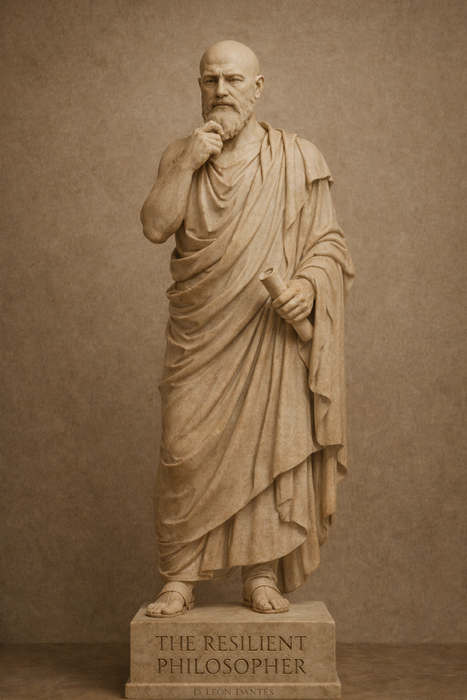
The Resilient Philosopher
There is one reality.
That statement matters. Without it, nothing holds.
And yet, within that single reality, every human being experiences life differently. Different pain thresholds. Different emotional tolerances. Different moral frameworks. Different psychological wiring. Different cultural conditioning. Different memories of the same moment.
That is not a contradiction.
That is the human condition.
I have been in accidents. I have witnessed them. I have listened to others recount the same event from entirely different angles. The accident happened. Metal collided. Physics did not care about opinion. But each person experienced the event uniquely. Each witness noticed something others did not. Each memory filled in gaps the others missed.
This is why perspective matters.
And this is why silencing perspective is dangerous.
One Event Does Not Mean One Experience
When an accident occurs, investigators do not silence witnesses. They collect them.
Why?
Because truth is reconstructed, not assumed.
Each perspective adds resolution. Each account adds context. Each observation, even flawed or incomplete, helps recreate the scene. The event remains singular, but understanding becomes collective.
This is not relativism. This is realism.
There was an accident. That truth stands.
But no single person holds the entire picture.
That principle applies far beyond accidents. It applies to history, psychology, leadership, governance, and science itself.
Perspective Does Not Erase Truth. It Completes It.
We often confuse perception with distortion. That is a mistake.
Perception is how truth becomes accessible to human beings.
Emotion exists on a spectrum. Pain exists on a spectrum. Psychological resilience exists on a spectrum. Personality exists on a spectrum. That is why no two people experience the same moment identically, even when they agree on what happened.
Ignoring psychological reality does not make society rational.
It makes it blind.
Diversity of perspective is not a flaw in human systems. It is an adaptive feature. It allows societies to detect danger, preserve memory, innovate, stabilize chaos, and learn from mistakes.
If everyone perceived reality the same way, society would stagnate.
Why Science Is Built on Shared Reality and Open Data
This is where science becomes essential.
Science assumes one underlying reality governed by consistent laws. That is its foundation. What makes science unique is not certainty, but method.
Science advances through:
- Data collection
- Testable hypotheses
- Replication
- Transparency
- Peer scrutiny
If one group observes a phenomenon, it is not enough. Independent groups must be able to reproduce it under similar conditions. That is how science constrains our understanding of reality within reliable bounds.
Replication does not mean identical experience. Different research teams notice different anomalies, emphasize different variables, and interpret implications differently. That does not weaken science. That is how science corrects itself.
Reality is singular.
Access to it is probabilistic.
And none of this works without sharing data.
If knowledge is hidden, science stagnates. If failures are buried, error persists. If methods are obscured, power concentrates. Science progresses not through certainty, but through exposure.
This is not optional. It is the engine.
Philosophy Asked the Question. Science Tested It.
Historically, science did not emerge in opposition to philosophy. It emerged from it.
Before laboratories, there was natural philosophy. Before experiments, there were questions.
What is matter?
What causes motion?
What governs the heavens?
What is life?
Philosophy asked what might be true. Science developed the tools to test it.
A philosopher concerned with awareness, ethics, and human flourishing must accept empirical evidence when it is robust and reproducible. Otherwise, philosophy collapses into ideology.
Philosophy does not get to veto reality.
It can interpret it. Contextualize it. Question implications. But it cannot deny evidence without abandoning its purpose.
Covering the sun with your finger does not erase the sun. Light still exists. Heat still exists. Reflection still exists. Even the moon bears witness.
Denying evidence is not skepticism.
It is willful blindness.
And blindness at scale is unethical.
Why Free Speech Is a Knowledge Issue, Not Just a Political One
Free speech exists because humans are limited observers.
Silencing voices does not create unity. It creates blind spots. And blind spots are where injustice hides.
When speech is suppressed, data is lost. Context disappears. Minority experiences vanish. Future generations inherit gaps instead of understanding.
Societies that allow expression become noisy, but resilient. Societies that suppress expression become confident, but fragile.
This is why the American Constitution remains radical.
Not because it is perfect, but because it allows itself to be criticized. The right to challenge the system without punishment is the feature people forget.
The people are sovereign. Government is a tool. Power flows upward, not downward.
When we forget that, we stop governing ourselves and start serving authority.
Government, Work, and Structural Dignity
A civilized society is not defined by handouts or dependency. It is defined by opportunity.
People should work. But they should not work until exhaustion and still live in poverty. That is not efficiency. That is extraction.
If we want smaller government, people must not be dependent on government to survive. That means living wages, corporate responsibility, and economic equity, not enforced sameness, but real opportunity to rise.
There will always be leaders. There will always be wealth differences. But a society that tolerates permanent poverty while calling itself civilized is lying to itself.
Poverty at scale is not a personal failure.
It is a systems failure.
One Reality, Many Observers, Shared Responsibility
There is one reality.
There are many perspectives.
Both matter.
Truth is not strengthened by suppression. It is strengthened by accumulation.
History becomes accurate through context. Science advances through sharing. Democracies survive through dissent. Leadership works through restraint.
This is why I record my podcast in one take. Minimal editing. Thought in motion. Silence allowed. No performance.
This is why live sessions matter. Not to be right, but to observe together. To speak without armor. To listen without planning rebuttals. To leave room for what has not yet been noticed.
That is how people grow without breaking.
This is my perspective. My reality. And I know it is incomplete.
That is why I listen.
Leave a Reply