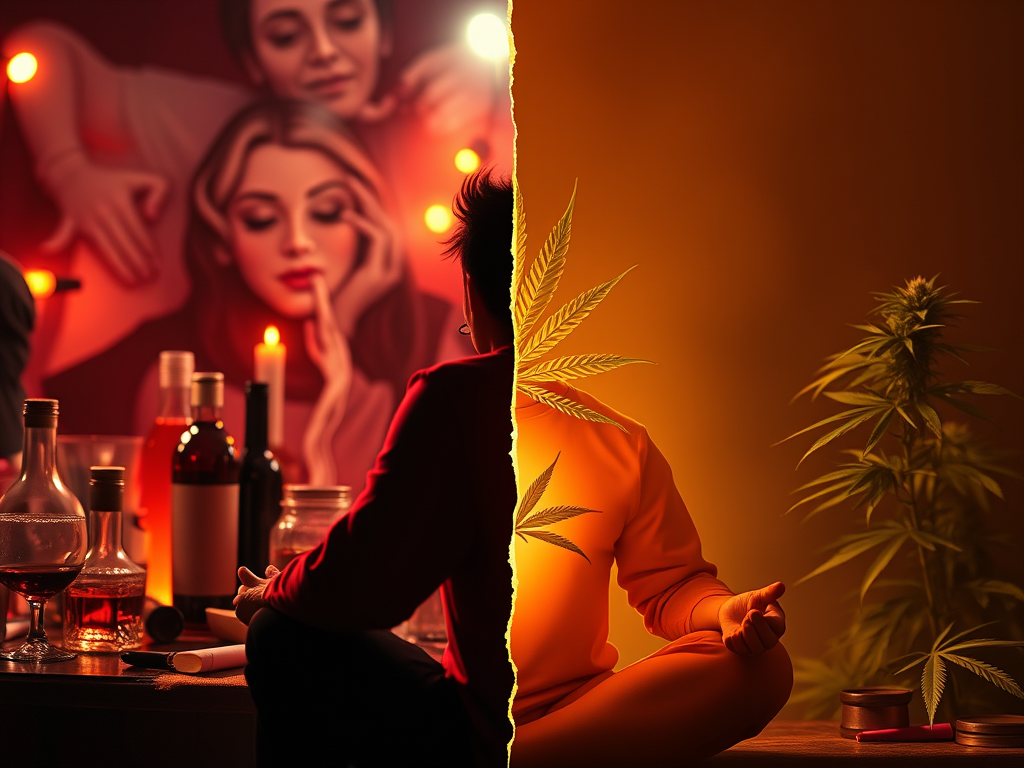
Introduction: When the Real Gateway Was Never Cannabis
People repeat the same old story that cannabis is a gateway drug. I used to believe that too, until I looked back at my own life with sincerity and the awareness that my experience did not match the narrative I was taught. Cannabis was not my gateway drug. Cigarettes were. Alcohol was. These legal, accessible, and socially accepted substances were the ones that opened the first door.
My first illegal drug was not cannabis. It was cocaine. Then came ecstasy and many others. Cannabis arrived at the end of the chain, not the beginning, and ironically it slowed me down long enough to ask myself who I was becoming.
Looking back through the lens of The Resilient Philosopher, I see the deeper truth. I was bipolar without knowing it. I was ADHD without understanding it. My emotional storms were never caused by a plant. Cannabis simply illuminated what I had been running from. It never cured my depression, because depression is a silent truth that forces us inward. No substance can replace the work that pain demands. Pain sharpens survival. Emotions remind us that we are still alive.
I am not advocating drugs. I am advocating honesty.
The Hypocrisy We Ignore: Legal Drugs Are the True Gatekeepers
Society attacks cannabis while glorifying alcohol, tolerating cigarettes, and normalizing over the counter medications that kill far more people each year. This is not about opinion. It is about measurable scientific reality.
Alcohol
• Responsible for more than 3 million deaths annually worldwide according to the World Health Organization.
• A major contributor to domestic violence, homelessness, liver disease, addiction, and fatal car accidents.
• Framed as celebration and reward in commercials and social events.
Cigarettes
• Cause over 8 million deaths every year.
• Marketed for generations to children, soldiers, athletes, and working families.
• Protected for decades by lobbying and political alliances.
Cannabis
• Zero recorded overdose deaths.
• Lower dependency rate than alcohol, nicotine, or prescription opioids.
• Demonstrated therapeutic potential for anxiety, chronic pain, epilepsy, PTSD, and inflammation.
• Criminalized for economic and racial motives, not for safety.
The gateway was never a plant. The gateway was social conditioning.
What Cannabis Actually Did for Me
Cannabis never felt like escape. It felt like a pause. It slowed the chaos of an untreated mind long enough for me to understand my emotions. Cannabis softened certain parts of my life, but it never cured my depression and never replaced therapy or medication.
Depression is not a wound that cannabis can close. Depression is the quiet room inside our minds where we meet ourselves without distractions. When depression arrived, cannabis changed nothing because cannabis cannot rewrite the internal story of a wounded mind.
Leadership begins with responsibility for the self. No substance carries that responsibility for us. That is the work of awareness, introspection, and emotional honesty.
The Science, the Fear, and the Narrative: Why Risk Alone Does Not Define Truth
Recently I read that THC may increase the risk of heart problems. I do not dismiss that possibility. I respect the science even when it challenges my viewpoints. But here is what I truly believe.
Anything and everything can be harmful. Any medication, supplement, or treatment, whether legal or illegal, carries risks. Even emotions carry risks. Stress alone damages the heart. Fear can paralyze the body. Grief can weaken the immune system. Nothing in life is ever perfectly safe.
The problem is not the existence of risk. The problem is fear being weaponized to control public perception.
Fear is one of the most powerful tools used by governments, corporations, media, and institutions. If you repeat a fearful message often enough, the public stops thinking. They stop questioning. They surrender their judgment to whoever speaks with authority.
So when someone says THC can cause heart problems, I ask the same questions I ask about everything else.
Where is the context
Where is the dosage
Where are the pre existing conditions
Where is the comparison to alcohol, nicotine, processed foods, sleep deprivation, stress, and every other legal habit that destroys the human body every day
When cannabis is put under a microscope while alcohol and nicotine get a spotlight, it is not about science. It is about narrative control. The science shows potential risks, but those risks must be compared to the risks of every other normalized behavior. Until then, fear remains the most persuasive substance society distributes.
Risk is part of life. Honesty is what makes us resilient.
The Real Conversation: Leadership, Awareness, and Human Choice
I believe every medication should be used responsibly and as needed. No drug is harmless. Every substance interacts with the body differently depending on our biology, our mind, and our emotional state. Leadership of the self means understanding why we reach for any substance in the first place.
The Resilient Philosopher teaches that pain is a messenger. Pain is not meant to be numbed without understanding its meaning. Pain tells us to change something within or around us. It guides us back to awareness.
I survived because I chose to face myself, not escape myself. I chose to understand my mind rather than silence it. No drug can take responsibility for my healing. That is a journey only self awareness can guide.
Scientific Reality: What the Data Actually Says
Here is the verified research that exposes the bias:
1. Mortality Comparison
Scientific Reports demonstrated that alcohol is approximately 114 times more deadly than cannabis.
2. Addiction Potential
NIDA reports the following addiction rates:
• Nicotine up to 32 percent
• Alcohol around 15 percent
• Cannabis around 9 percent
3. Therapeutic Impact
• CBD approved by the FDA for epilepsy.
• THC and CBD shown to reduce chronic pain in systematic reviews.
• PTSD patients show short term symptom reduction in several clinical studies, although results vary.
4. Cardiac Risks
Peer reviewed cardiology studies show that THC can elevate heart rate and may increase risk for individuals with pre existing cardiovascular issues. Context, dosage, and frequency shape the actual risk.
This is why education must replace fear.
Conclusion: The Exposé We Needed Instead of Fear
Cannabis did not start my descent into substance use. Legal drugs did. My emotional wounds did. My undiagnosed conditions did. Cocaine came before cannabis in my story. Pain guided my choices long before I knew how to navigate them.
Cannabis did not ruin my life. It helped me see parts of myself more clearly. It never cured my depression because depression requires introspection, treatment, and emotional courage. No drug, legal or illegal, carries the responsibility to heal us.
Fear has shaped society for too long. Fear has dictated laws, destroyed lives, and manipulated generations into accepting half truths as absolute truths.
We must stop treating cannabis as the villain of a story that was written by industries far more harmful than any plant. If we want people to heal, we must offer truth instead of fear, awareness instead of judgment, and responsibility instead of stereotypes.
This is my exposé.
This is my experience.
This is the voice of The Resilient Philosopher.
Call to Action
If this reflection challenges the narratives you were taught, share it with someone who needs clarity in a world overloaded with fear. Healing begins with honest conversations, and leadership begins with the courage to question everything.
Peer Reviewed Sources
Cannabis, THC, and Cardiovascular Health
• Menahem, S., & Shvartzman, P. (2014). Is Cannabis Harmful for the Heart Journal of the American Heart Association.
• Thomas, G., Kloner, R. A., & Rezkalla, S. (2014). Adverse cardiovascular effects of marijuana inhalation Circulation.
• Richards, J. R. (2020). Cannabis and heart health Progress in Cardiovascular Diseases.
Cannabis Mortality and Overdose
• Nutt, D. J., King, L. A., & Phillips, L. D. (2010). Drug harms in the UK The Lancet.
• Lachenmeier, D. W., & Rehm, J. (2015). Comparative risk assessment of alcohol, tobacco, cannabis and other illicit drugs Scientific Reports.
Addiction Probability
• Lopez Quintero, C., et al. (2011). Predictors of transition to drug dependence Drug and Alcohol Dependence.
• Anthony, J. C., & Petronis, K. R. (1995). Early onset drug use and later problems Drug and Alcohol Dependence.
Mental Health and Therapeutic Use
• Crippa, J. A. S., et al. (2018). CBD as a treatment for anxiety Neurotherapeutics.
• Lev Ran, S., et al. (2013). Cannabis and depression Journal of Affective Disorders.
• Bonn Miller, M. O., et al. (2014). Cannabis and PTSD symptoms Journal of Psychoactive Drugs.
• Wilkinson, S. T., et al. (2016). Cannabis outcomes in PTSD Journal of Clinical Psychiatry.
Medical Benefits of Cannabis
• National Academies of Sciences (2017). The Health Effects of Cannabis and Cannabinoids.
• Whiting, P. F., et al. (2015). Cannabinoids for medical use JAMA.
• Devinsky, O., et al. (2017). CBD for epilepsy New England Journal of Medicine.
• Blessing, E. M., et al. (2015). CBD as treatment for anxiety Neurotherapeutics.
Alcohol and Tobacco Harm Data
• Shield, K. D., et al. (2020). Global alcohol exposure The Lancet.
• Griswold, M. G., et al. (2018). Alcohol burden The Lancet.
• Jha, P., & Peto, R. (2014). Global effects of smoking New England Journal of Medicine.
• Carter, B. D., et al. (2015). Smoking and mortality NEJM.
History and Sociology of Drug Criminalization
• Alexander, M. (2010). The New Jim Crow.
• Svrakic, D. M., et al. (2012). Legal and cultural aspects of cannabis Missouri Medicine.
• Reinarman, C., & Levine, H. G. (1997). Crack in America.
• Musto, D. F. (1999). The American Disease.
Further Reading for Deeper Understanding
- Hall, W., & Degenhardt, L. (2014). The adverse health effects of chronic cannabis use and dependence The Lancet.
- Volkow, N. D., et al. (2016). Effects of cannabis use on human behavior NEJM.
- Hasin, D. S., et al. (2015). Prevalence of marijuana use disorders JAMA Psychiatry.
- Earleywine, M. (2005). Understanding Marijuana: A New Look at the Scientific Evidence.
- Hart, C. (2013). High Price.
- Caulkins, J. P., et al. (2016). Marijuana Legalization: What Everyone Needs to Know.
Leave a Reply